
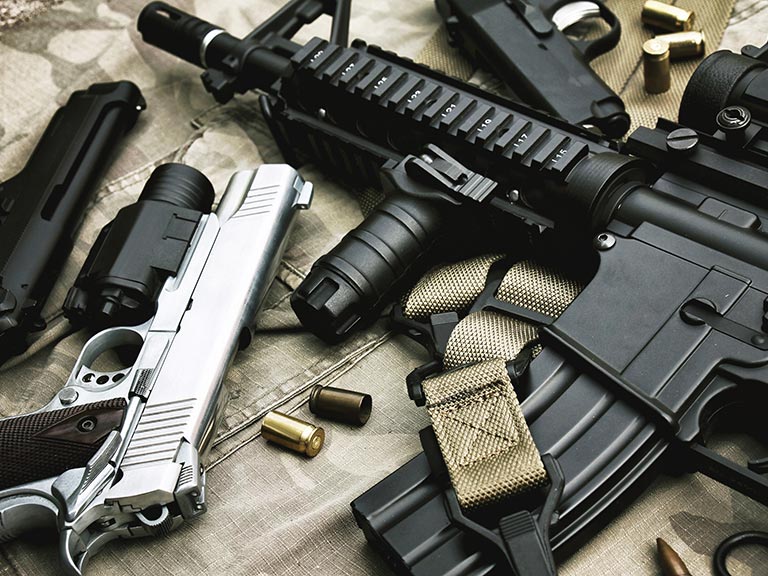
Your First Firearm in Massachusetts.
Massachusetts is one of the hardest places in the country to buy a gun, and one of the easiest places to make an expensive mistake doing it. This is the page we wish every new buyer read before they walked into a shop — ours or anyone else’s.
The License Comes First. Always.
In Massachusetts, you cannot legally purchase, possess, or take home anything serialized — or anything that uses a propellant (aka bullet) — without a valid License to Carry (LTC) or Firearms Identification Card (FID). That includes the firearm itself. It includes a receiver. It includes the frame. It includes a single round of ammunition. It includes the can of bear spray you saw at the counter.
We get the call almost every day: “I’d like to come pick up that pistol.” Great — have an LTC? “Oh, I don’t have one yet.” Then we have to deny them, and we hate doing it. So we’re putting this at the top of the page. If you don’t have your license yet, stop reading the rest of this guide and go get one. Everything below this line will still be here when you come back.
Massachusetts LTC Course (LTC-033)
The MSP-approved Basic Firearms Safety class taught at our Woburn facility. Classroom format, no live fire. This is your ticket to apply for an LTC or FID at your local PD. Without it, the rest of this page is theoretical.
It Will Feel Overwhelming.
That feeling is correct. You’re not making it up. Buying your first firearm in Massachusetts is harder than it should be, can be more expensive than you expected, and surrounded by enough conflicting information online to make anyone close the tab and walk away. Don’t.
Here’s the secret nobody on the internet wants to tell you: your dealer is the resource. Not the YouTube guy in a desert state where everything is legal. Not the forum post from 2019. Not your cousin in New Hampshire with 75 firearms. And — this surprises people — not your local PD’s front desk either; officers are trained on enforcement, not on the retail side of the law. The dealer in front of you has a Federal Firearms License on the wall and a Massachusetts dealer license next to it, and if they hand you the wrong thing they lose both. Their incentives are exquisitely aligned with yours.
Walk in. Tell us you’re new. Tell us what you want the gun to do. We will tell you what’s compliant, what isn’t, what fits your hand, and what you should avoid. There are no stupid questions in our shop — the only stupid move is buying something out of state that turns into a felony when it crosses the border.
The single most important word for the rest of this page is compliant. Cool isn’t compliant. Affordable isn’t compliant. Compliant is compliant. Everything below is the short version of how to recognize it.
Three Buckets. Know Which One You’re In.
Massachusetts treats long guns, handguns, and frames/receivers as three different legal animals. Memorize this much and you’re already ahead of most first-time buyers walking through the door.
Rifles & Shotguns
No roster. Long guns are not subject to a roster — FCAB confirmed this in February 2025. The hard rule is that rifles and shotguns cannot violate the Assault-Style Firearm law (the “ASF” / features test), and centerfire semi-autos with a detachable magazine and two or more enumerated features must have been lawfully possessed and serialized in MA on August 1, 2024. Bolt, lever, pump, and feature-compliant semi-autos are fair game.
Handguns
Roster + AG guidelines. A handgun must be on the EOPSS-published Approved Firearms Roster and meet the Attorney General’s Handgun Sales Regulations (940 CMR 16.00). Two separate gates, both required. The roster gets updated; the AG regs apply at point of sale. If a pistol isn’t on the roster, no licensed dealer in Massachusetts can hand it to you. Period. Keyword: handgun.
Frames & Receivers
The frame game. Chapter 135 of the Acts of 2024 redefined “firearm” to include frames and receivers — which created a regulatory question, since you can’t roster-test a frame. FCAB has guided that frames be treated like long guns: regulated as firearms, not subject to the handgun roster. That means a frame can be transferred to a licensed buyer even if the completed pistol isn’t on the roster. It’s the legal door that exists, and we walk through it accordingly.
How can I buy a frame for a pistol that isn’t on the roster?
Short version: frames are firearms, but they aren’t handguns for purposes of the roster. Massachusetts General Law Chapter 140, § 121 lists what counts as a “firearm” and includes frames and receivers. The roster authority — § 131¾ — uses the word “firearm” but pulls its testing standards from § 123, which contemplates a complete, functional handgun (slide, barrel, breechblock, the whole package).
A frame, by itself, can’t be put through a 600-round drop and reliability test. There is no slide on it. There is no barrel on it. The Firearm Control Advisory Board worked through this in early 2025 and concluded — using the same “context” provision in § 121 that exempts long guns — that the testing regime can’t be applied to frames, and therefore frames don’t belong on the roster.
That guidance is advisory, not statute. But it is the position the FCAB has taken on the record, and it is the framework licensed dealers are operating under. So any frame can be transferred to a licensed buyer through an FFL, regardless of whether the finished pistol it’s destined to become would be roster-eligible. It is built. It is registered. It is yours. That’s the door.
Citations: M.G.L. c. 140, § 121 (definition of “firearm”); § 123 (handgun testing); § 131¾ (roster authority); FCAB Roster Subcommittee Memo (Feb 14, 2025); FCAB meeting minutes (Apr 2025); EOPSS Guidance #4 (2024 Firearms Act). This is a summary, not legal advice.
The frame game is legal under current state guidance, and we transfer them. It is also a moving target — the Legislature, EOPSS, and the courts can all change what’s permitted. What’s compliant today may not be compliant tomorrow. If you build on a frame, build on a frame your dealer is comfortable transferring, and follow the law as it actually reads at the moment of the build.
What’s This Gun For?
Before you fall in love with a brand or model, decide what role this firearm is going to fill. The right answer for a competition shooter is the wrong answer for a homeowner, and the right answer for a homeowner is the wrong answer for someone planning to carry concealed. Pick a lane.
Range & Target
You want to learn the fundamentals, train regularly, and have a fun reason to leave the house on a Saturday. Most first guns live here.
Home Defense
You want a tool you trust to protect your family inside your four walls. Reliability, simplicity, and effective ammunition matter more than anything else.
Conceal Carry
You have your LTC and you intend to carry a handgun on your person. The gun is a small, last-resort tool. Comfortable to hide, painful to shoot a lot, designed to do one job at very close range.
Sport & Competition
USPSA, IDPA, steel challenge, PRS — competitive shooting is the fastest way to actually get good. The gear gets nicer. The hobby gets expensive. You’ll love it.
Whichever lane you pick, the cheapest and most effective fundamentals trainer ever invented is a .22 LR pistol or rifle. Ammo costs a fraction of 9mm, recoil is essentially zero, and the trigger discipline you build with 500 rounds of .22 transfers directly to your defensive gun. Many serious shooters keep a .22 next to their carry pistol forever. If you can swing it, plan a .22 alongside your first centerfire purchase — not instead of it.
Got an answer? Good. That answer routes you to one of three platforms below: pistols, shotguns, or rifles. Most first-time buyers in Massachusetts end up on a pistol — so we’ll start there.
More Often Than Not, Your First Gun Is a Pistol.
They’re versatile, they’re the platform you trained on in your LTC class, and Massachusetts has a healthy roster of options once you know where to look — plus frames. For the average new buyer there are essentially three jobs a handgun gets bought to do: conceal carry, home defense / range use, and competition.
Each one points you at a different size class of pistol. The same gun is rarely the right answer for all three — a competition gun is too big to carry, a carry gun is unpleasant to shoot all day, and the perfect home-defense pistol probably wants a specific light and a red dot you wouldn’t bolt to a CCW. Pick the job. Pick the right tool for the job. We’ll hand you the rest.
A carry gun is a compromise machine. You give up sight radius, slide mass, magazine capacity (in free states), and grip real-estate to gain something more important: the gun gets carried. The pistol that gets left in the safe because it’s too big to conceal protects no one. Subcompacts (think 10–12 oz, 3" barrel range) are the most concealable; compacts (15–20 oz, 3.5–4" barrel) split the difference and shoot noticeably better. New carriers tend to start with a compact, work up to a subcompact when they’re confident, then end up with one of each.
And remember — in Massachusetts, concealed carry means concealed, and the legal threshold for a defensive draw is narrower than most new carriers realize. Train hard. Know the law cold. Treat a draw as the last thing you ever want to do.
These aren’t all of the options out there — not even close. They’re the options we’ve personally run at some point ourselves, trust, and genuinely appreciate for their performance and reliability. If you don’t see your top pick on the list, ask us — chances are we’ve shot it, sold it, or can get it.
Sig Sauer P365
The pistol that rewrote what a subcompact could be. 10+1 in a frame the size of a deck of cards, surprisingly shootable, dot-ready. The default first carry gun for a reason. Uber compliant, loved by Massholes.
Glock 43X
The single-stack slimline Glock that made everyone reconsider the superiority of Glock. Boring in the best way. Runs everything, hides anywhere, fits the hand proper.
Heckler & Koch CC9
HK’s purpose-built micro-compact carry gun. Slim grip, low bore axis, optic-ready, and the trigger HK refuses to ship anything else with. Built for one job: disappear and still shoot like an HK.
Smith & Wesson Shield Plus X-Comp
The Shield-X PC reimagined with an integral compensator. Tames the snap of a micro-compact without growing the footprint. A new benchmark for shootable carry.
Heckler & Koch VP9 K
HK’s compact answer to the VP9. Same crisp trigger, same German fit, sized down for daily carry without giving up shootability. The thinking carrier’s compact.
Glock 19 Gen 6
The next iteration of the most-recommended handgun in America. Refined ergonomics, factory optic cut, and the same do-everything footprint that made the 19 a household name. My go-to.
Walther PDP Compact
Walther’s compact PDP — aggressive grip texture, performance trigger, optic ready. The dark horse pick that out-shoots its price every time. The best trigger of any striker-fired pistol on this page, period.
Smith & Wesson M&P9 Compact
The American compact that quietly does everything right — refined ergonomics, factory optic cut, M2.0 trigger, and a price that leaves room for ammo and training.
The full-size duty pistol — VP9, Glock 17, M&P 2.0, Walther PDP — is the platform police departments actually carry, the platform militaries actually issue, and the platform anyone serious about defensive shooting trains on. The recoil impulse is softer because there’s more gun in your hand. The sights are farther apart so you shoot more accurately. There’s plenty of real estate for a full-sized weapon light, and most modern duty guns are optics-cut from the factory. Remember, red dots are the future, and the future is now.
For a bedside gun (properly stored to prevent unauthorized use, ammo separate — we cover storage in detail in Section 08), this is what you want. For a weekly range gun, this is what you want. If you’re not carrying every day, you should probably start here and add a carry gun later — not the other way around.
These aren’t all of the options out there — not even close. They’re the options we’ve personally run at some point ourselves, trust, and genuinely appreciate for their performance and reliability. If you don’t see your top pick on the list, ask us — chances are we’ve shot it, sold it, or can get it.
Heckler & Koch VP9
The pistol that converted a generation of Glock-skeptics. Crisp trigger, ergonomics like nothing else in the segment, German fit-and-finish. Costs a little more. Earns it.
Glock 17
The duty pistol. The textbook full-size service Glock — the platform that defined what a duty handgun is, and the one a lot of working cops still carry. Boring, reliable, eternal. My go-to full size, my beater, my honeychild.
Smith & Wesson M&P 2.0
America’s duty pistol. Aggressive grip texture, 18-degree grip angle, a trigger that’s gotten progressively better with each generation. The M2.0 Metal version is genuinely outstanding for the money.
Walther PDP-X Full Size
The Pro-X is Walther’s comped-flavored take on the PDP — flat trigger, performance-spec slide, optic ready, full-size grip. The duty PDP’s shooty cousin, ready out of the box.
Read this section for context, not for shopping. A first-time buyer should not start here. These are the guns you graduate to once you’ve built fundamentals on a duty pistol, lost a match or two, and decided you’re addicted enough to spend the money. Skip ahead to Section 06 if you’re still on gun number one.
At some point in the hobby — usually after the second or third year, usually after you’ve shot a couple of matches or at least seen them on the socials, after you’ve heard a friend talk about a “stage time” you cannot comprehend — you’ll start looking at metal-framed competition pistols. The Kimber 2K11 series. The Sig GTO. The Alpha Foxtrot Romulus. The CZ TS 2. Staccato. Atlas. The list keeps growing and the price keeps rising.
These are not duty guns. They are not carry guns. They are shooting guns — built around red dot optics, flat triggers, magwell extensions, and a recoil impulse so flat you’ll think it’s a BB gun. The grip is steel and aluminum where the duty gun was polymer; the trigger is short, crisp, and adjusted to the gram. A first-time buyer probably shouldn’t start here. A second- or third-time buyer absolutely will.
A small sample of the many we stock and can source. Talk to us about what you’re actually trying to do — we’ll point you at the right tool.
Kimber 2K11
Kimber’s entry into the modern double-stack 2011 race — aluminum or steel grip module, flat trigger, optic-cut slide. A real contender for the price, and a serious shooter out of the box.
Sig Sauer GTO
Sig’s full-size, all-metal, optic-ready competition build on the X-Series chassis. Tungsten grip module weight, integrated compensator options, factory flat trigger. The recoil impulse is unreal. Still a Sig, though.
CZ TS 2
The competition-bench standard. All-steel frame, fiber sights, factory-tuned single-action trigger. Heavy on purpose — recoil disappears, splits get stupid fast. The shooter’s shooter.
Alpha Foxtrot Romulus
A modern 1911 that respects the platform and updates everything that needed updating. Tight tolerances, optic-cut slide, threaded for a comp, fiber-optic sights. The 9mm 1911 done right and the best bang for your buck on the market.
Comparable platforms — Alpha Foxtrot Romulus, CZ Shadow 2 / TS 2, Staccato XC, Atlas Erebus, Walther Q5 Match SF — are stocked or available to order. Talk to us. Bring your desires and your budget.
The Most Underrated First Gun in Massachusetts.
Shotguns are not subject to a roster. They are the simplest action types to learn. They are devastating at home-defense distances and a tradition unto themselves at the trap and skeet field. They are also the platform Massachusetts hassles you about the least — which, frankly, matters. Funny how that works: the most brutal delivery of lead, and the platform our politicians worry about least. Go figure.
For new buyers, shotguns split into two clean families: defensive shotguns (shorter-barrel, manual or semi-auto, designed for hard use) and sporting shotguns (longer barrels, lighter loads, traditional wood & blued steel, built to break clays for fifty years and look good doing it). Same legal bucket, different jobs.
On the defensive side, the conventional wisdom — pump-action 12-gauge, 18–20" barrel, extended magazine tube, ghost ring or red dot — has not been greatly improved upon for a reason. If you want the simplest, most reliable thing in your house at 2:00 AM, this is it. Step up to a semi-auto if you want softer recoil and faster follow-ups. Recently, the developments and reliability of semis have become incredible — long are the days of finicky semi-autos whose reliability depends on the load. On the sporting side, an over-under in 12 or 20 gauge is the start of a lifetime hobby and a means of spending an incomprehensible amount of money on a firearm that holds two measly shells. It is a culture, and one day I may understand it. Both deserve a spot in this guide.
A small sample of the many we stock and can source. Talk to us about what you’re actually trying to do — we’ll point you at the right tool.
Mossberg 590A1
The mil-spec 590. Heavy-walled barrel, metal trigger group, metal safety, bayonet lug. The one Mossberg sells the government. If you want a pump shotgun you’ll never have to apologize for, this is the one. Marines can’t even break this thing.
Beretta A300 Ultima Patrol
The accessible end of Beretta’s defensive semi-auto line. Inertia-driven, soft-shooting, optic-ready, ghost-ring sights from the factory. If you want a semi-auto home-defense shotgun and don’t want to spend 1301 money, this is the answer.
Beretta 1301 Tactical
If money is no object — or if you’ve talked yourself into spending the money anyway — the 1301 is the home-defense semi-auto everyone in the know quietly recommends. Faster cycling than seems physically possible. Beloved for a reason.
Beretta 686 Silver Pigeon
The over-under that taught a generation to break clays. Walnut stock, engraved silver receiver, proper ergonomics. Buy it once. Pass it down.
Once Great in Mass. Now a Different Game.
We’re not going to sugarcoat this. Rifles — particularly semi-automatic centerfire rifles like the AR-15 and comparables — were the platform that took the hardest hit in 2024. Chapter 135 closed the door on August 1, 2024, and the supply of grandfathered, full-featured semi-autos has been frozen ever since. Prices on pre-ban inventory have done what supply-shocked markets always do: skyrocketed.
What’s left for new buyers in Massachusetts is a real, viable, sometimes very interesting set of three categories: bolt-action rifles, lever-action rifles, and feature-compliant (“neutered”) semi-autos. Bolts and levers were never affected by the AWB and are entirely fair game — you can buy a Tikka, a Seekins, a Henry, or a Marlin tomorrow and have your pick of caliber and configuration. The semi-auto compliant rifle is its own genre at this point, and a few manufacturers have done the engineering work to deliver a real rifle inside the rules.
And worth repeating from Section 04: a .22 LR rifle — bolt-action or semi-auto — is the most underrated first centerfire-adjacent purchase a new shooter can make. Cheap to feed, painless to learn on, and a rifle you’ll keep for life. 22's are also now excluded from ASF feature tests.
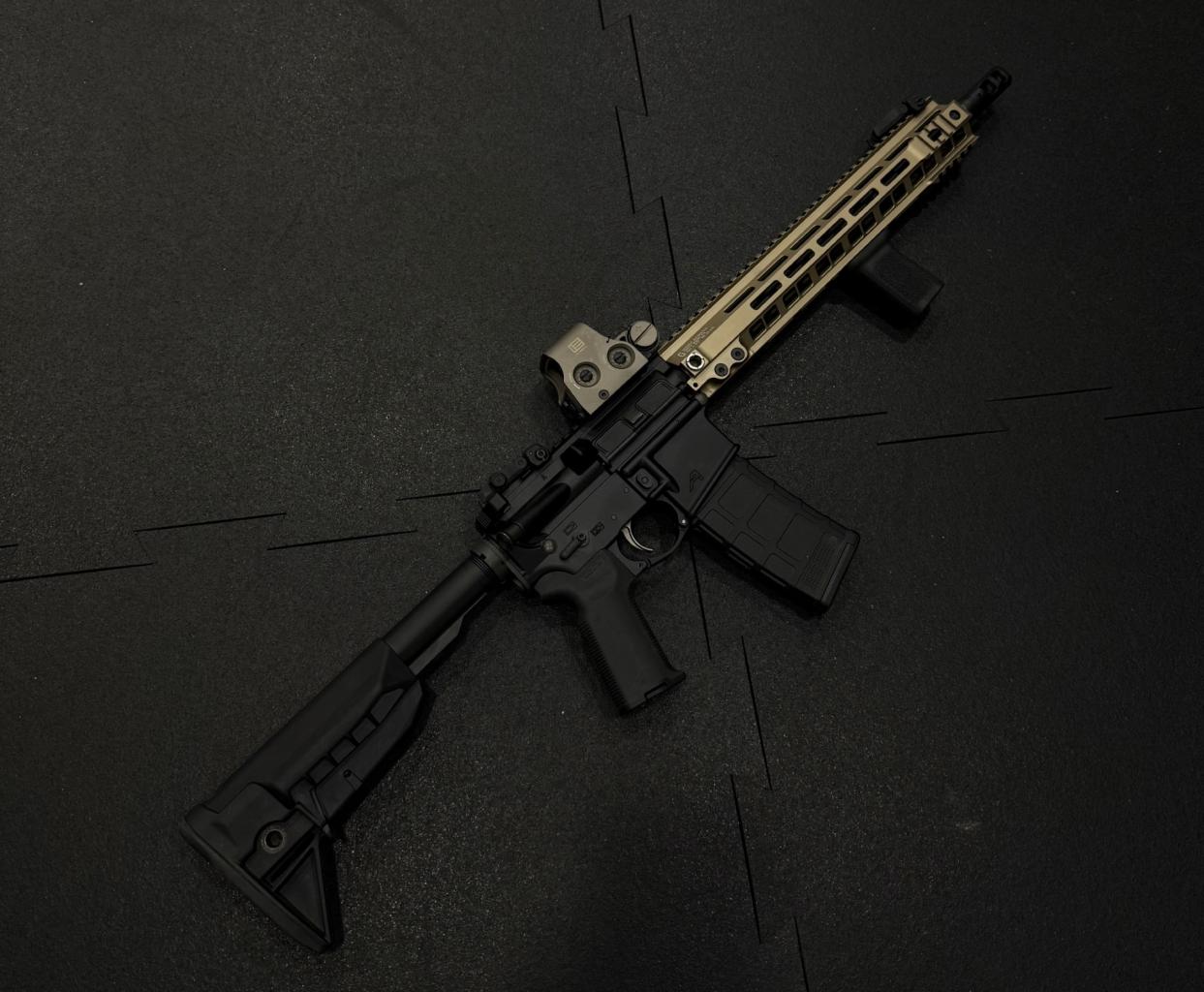
The Featured AR-15 in Massachusetts — Hard to Source, Heavily Inflated.
Anything not lawfully possessed, registered, and serialized in Massachusetts on August 1, 2024 cannot be transferred to an in-state buyer. Pre-ban inventory still moves through used channels, but expect to pay considerably more than MSRP — sometimes double — and expect the selection to be limited.
We carry pre-ban when we can source it cleanly. Ask, and we’ll be honest about what’s available, what it’s running, and whether the math actually pencils for what you’re trying to do.
For most new buyers, the desired path forward is a compliant semi-auto. Three platforms in particular are genuinely good rifles inside the rules — and they’re the ones we’d actually recommend.
A small sample of the many we stock and can source. Talk to us about what you’re actually trying to do — we’ll point you at the right tool.
CMMG Dissent
CMMG built the Dissent specifically for restricted states — non-pistol-grip stock, fixed-feature configuration, full AR-pattern internals. You get the AR you trained on, in a package that’s legal here.
Sig MCX Regulator
Sig’s piston-driven MCX with a fixed traditional stock and a redesigned lower — the elite rifle inside the ranch-rifle rulebook. Two-stage match trigger, ambi controls.
Ruger Mini-14
The original ranch rifle. Garand-style action, traditional stock, no evil features in any configuration we sell — legal in Massachusetts since well before any of these laws existed. Not as customizable, but utterly proven.
Bolt and lever options — Tikka T3X, Bergara B14 / HMR, Henry Big Boy, Marlin 1895, Ruger American — are also stocked or available to order, in calibers from .22 LR through .308 and beyond. Often the right answer for a first centerfire rifle.
The Gun is Yours. Now What?
Most first-time buyer guides stop at the cash register. Yours doesn’t. The hour you walk out of the shop is the start of three things you need to do right: finish the paperwork, store and transport it correctly, and have a productive first range trip. Massachusetts has specific rules for the first two and unforgiving expectations for the third. Here’s the short version.
ATF Form 4473
Your name, address, demographics, and a series of yes/no questions about prohibiting factors. Lying on it is a federal felony — answer honestly. If you’ve answered honestly, you have nothing to worry about.
Your dealer initiates the federal background check (NICS) the moment the form is complete. For LTC holders, this almost always returns Proceed in minutes.
FA-10 Transfer Report
The Massachusetts side. Your dealer files this electronically with the Firearms Records Bureau, recording the transfer and the serial number. You’ll see them scan your LTC and walk through the entry with you. This is how the firearm gets registered to you in MA.
Massachusetts has no waiting period for licensed individuals. If NICS returns Proceed and your LTC is valid, the gun goes home with you that day.
For Pickup
Three things, every time:
— Your LTC or FID card (the actual card, not a photo).
— Your LTC PIN — came with your license and needed for the MA Registration.
— Payment.
Delays do happen on NICS — a name match with someone else’s record, a typo, a federal system hiccup. They usually clear in a few business days. We’ll call you the moment yours does.
The governing statute is M.G.L. c. 140 § 131L. The plain-English version: any firearm not under your direct control must be stored in a locked container, or be equipped with a tamper-resistant trigger lock. “Direct control” means on your person or within your immediate reach. Everything else — the gun on the nightstand while you shower, the gun in the closet while you’re at work, the gun in the car while you’re grabbing coffee — needs to be locked.
Locked Container or Lock
A real safe, lockbox, or cabinet — not a closet, not a drawer. A trigger lock that prevents the trigger from being pulled is also acceptable. Ammunition is best kept separately from the firearm.
Budget $100–$400 for a starter solution. We carry compliant options ranging from quick-access bedside safes to full-height long-gun safes. Ask, and we’ll match the safe to the gun.
Locked & Out of Sight
An unattended firearm in a vehicle must be in a locked container, and that container should not be visible from outside. Glove boxes and consoles do not count as “locked containers” for this purpose. A small portable safe tethered to a seat frame is the standard solution.
If the gun is on you under your LTC, you’re fine. The moment you step away from it, the locked-container rule kicks in.
Cased & Unloaded
A long gun should be cased and unloaded. A handgun should be cased, unloaded, and ideally locked. Magazines unloaded if you’re being careful. The case stays closed until you’re at your lane.
You don’t need the most paranoid possible interpretation, but you do need to be clearly in compliance if you’re stopped or asked. Visible firearms in a car are how easy days become hard ones.
- Eye protection — rated, wrap-around. Non-negotiable.
- Hearing protection — electronic muffs ($50–$80) let you hear range commands while protecting your ears.
- A brimmed hat. Hot brass finds open collars and gaps; a hat helps deflect.
- Closed-toe shoes with a high collar if possible. Same reason.
- The firearm in a case, per the transport rules above. Magazines unloaded.
- Ammunition — start with 100–200 rounds. You’ll shoot more than you think.
- Targets if your range doesn’t supply them.
- Lane fee or membership card — or cash for a day pass.
- Patience. Your first session is for learning the gun, not for impressing anyone.
Realistic Total Cost
Plan for it. The buyers who plan for it stay in the hobby; the ones who don’t fade out by month three because the gun got expensive faster than they expected.
The single best investment after the gun itself is professional instruction. One day with a real instructor will fix more bad habits than fifty trips to the range alone. We run defensive pistol fundamentals classes regularly — ask at the counter, or check the Training tab.
A Shield, A Skill, A Lifelong Pursuit.
Buying a firearm in Massachusetts is the start of three things at once: you have taken on a serious responsibility, you have acquired a tool that gives you the means to defend the people you love, and you have walked into a hobby that is genuinely — we have been told this by so many of our customers — one of the most rewarding skill-based pursuits an adult can take up.
The first range trip is awkward. The fifth one is fun. The fiftieth one is the calmest hour of your week, until you get a shot timer and set “standards” for yourself. Somewhere along the way you join a club, you shoot your first match, you teach your spouse, you watch your kid out-shoot you, you buy a second pistol, then a shotgun, then a rifle you don’t really need, then that scope you definitely don’t need. And the gun in the safe at home does its quiet, unobtrusive job — it sits there, ready, while you go on living the life it’s there to protect.
That is the entire point. Welcome to it.
- Get your LTC. If you’re reading this and don’t have one yet, take our LTC-033 course and apply.
- Define the mission. Range, defense, carry, sport — pick a lane before you pick a gun.
- Trust your dealer. Walk in with questions. Walk out with a compliant gun and a plan to learn it.
- Train more than you buy. The best gun in the safe is the one you’ve put a thousand rounds through.
- Store it right. Locked container, ammo separate, every time. Section 08.b is the one to bookmark.
- Stay current. Massachusetts firearms law changes; assume what you knew last year is partially wrong this year.
Come See Us in Woburn.
The fastest way past the overwhelm is to walk into the shop and start asking questions. We’ll show you what’s compliant, let you handle what fits, and send you home with the right first gun — or none at all, if today isn’t the day.
SUN: BY APPT.
MON-TUES: 12PM - 6PM
WED-FRI: 10AM - 6PM
SAT: 10AM - 3PM