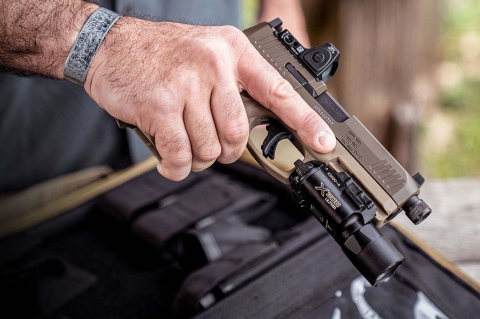
LTC-033  ·  MA STATE POLICE APPROVED  ·  WOBURN, MA

Massachusetts LTC Course

The Massachusetts State Police approved classroom course (LTC-033) required to apply for your License to Carry (LTC) or Firearms Identification Card (FID). Taught in Woburn, MA by NRA-certified and MSP-certified instructors at Vantage Defense.

Course Code
LTC-033
Format
Classroom
Live Fire
Not Required
Qualifies For
LTC  ·  FID
!
A note on the 2024 gun law and live fire. Under Chapter 135 of the Acts of 2024, Massachusetts added a live-fire component to the Basic Firearms Safety requirement. That live-fire requirement is not currently being enforced while the Massachusetts State Police, EOPSS, and the Firearm Control Advisory Board finalize the standardized curriculum and qualification standard. As of today, the classroom-only LTC-033 course is an approved path to your Basic Firearms Safety Certificate. There is no live fire with this course.

What Is The Basic Firearms Safety Course?

Massachusetts General Law Chapter 140, § 131P requires every first-time license applicant to complete a state-approved Basic Firearms Safety (BFS) course before applying to their local licensing authority.

LTC-033 is the course code assigned by the Massachusetts State Police to the NRA Home Firearm Safety course, as developed and delivered through Gun Owners' Action League of Massachusetts (GOAL). It is on the official MSP-approved course list and satisfies the training prerequisite for both the License to Carry and the Firearms Identification Card.

This is a non-shooting, classroom-based course. You will handle a variety of inert firearms under direct instructor supervision, learn how they function, how to load and unload them safely, how the law treats them in Massachusetts, and what it means to be a responsible steward of a firearm in your home.

Basic Firearms Safety classroom instruction at Vantage Defense
Classroom Instruction

Required By Law. Non-Negotiable.

Massachusetts is one of the most regulated firearms jurisdictions in the country. Without a completed Basic Firearms Safety Certificate on file, your local police department cannot legally process your LTC or FID application. Full stop.

Chapter 135 of the Acts of 2024 — the state's most significant firearms overhaul in a generation — modernized the training requirement to include instruction on de-escalation, suicide and injury prevention, and use-of-force law, on top of the traditional safe-handling curriculum. The LTC-033 curriculum covers these areas.

You need this course if you…

  • Are applying for your first Massachusetts LTC (License to Carry, ages 21+)
  • Are applying for your first Massachusetts FID card (ages 15+, or 14 with parental consent)
  • Received your license after August 1, 2024 and are now renewing under the new curriculum requirement
  • Let a previous Massachusetts license lapse and need to re-apply
  • Are moving to Massachusetts and need to apply for a resident license within 60 days

What You'll Learn — The 9 Course Modules

Our LTC-033 course is built around the NRA Home Firearm Safety core curriculum, reinforced with the GOAL Massachusetts Gun Law Reference (revised April 2025) and the expanded topic requirements under Chapter 135 of the Acts of 2024. Over roughly four hours in our Woburn classroom, we cover the following nine modules in sequence.

MOD 01

Rules for Safe Gun Handling

The three rules. Every firearm, every time.

MOD 02

Identifying Different Firearms

Action types, categories, and safe unloading.

MOD 03

Practical Exercises in Safe Gun Handling

Hands-on familiarization with four firearm types.

MOD 04

Ammunition, Cleaning & Storage

Cartridge basics, caliber, cleaning, and storage.

MOD 05

Massachusetts Firearms Law

M.G.L. c. 140 — what you're allowed to do.

MOD 06

Firearms Licensing & Process

FID vs. LTC and the six-step application.

MOD 07

Common Mistakes & Misconceptions

The errors that get good people in trouble.

MOD 08

Self-Defense & De-Escalation

Self-defense law, Castle Doctrine, and de-escalation.

MOD 09

Firearms & Suicide Prevention

The data, the science, and what you can do.

Firearms You'll Handle In Class

During Module 03 (Practical Exercises), you'll receive direct instructor-led, hands-on familiarization with all four of the firearm types below. Every demonstration is done with inert training firearms — no live ammunition, no range time, no prior experience required.

01

Semi-Automatic Pistol

Magazine-fed handgun. The most common platform in the U.S.

02

Revolver

Rotating cylinder handgun. Simple and reliable.

03

Semi-Automatic Rifle (AR-15 Platform)

The most common centerfire rifle in America.

04

12-Gauge Pump-Action Shotgun

Manual action. Exempt from the MA AWB.

Are You Eligible For A Massachusetts License?

Completing this course is step one. But Massachusetts also imposes statutory disqualifiers and a "suitability" review by your local licensing authority. Make sure the following apply to you before you invest in the course.

You must be able to say yes to all of these:

  • 21 years or older for an LTC (15+ for FID)
  • U.S. citizen or lawful permanent resident
  • No felony convictions
  • No active restraining or harassment orders against you
  • Never dishonorably discharged from the armed forces
  • Never adjudicated mentally incompetent by a court
  • No DUI convictions in Massachusetts after 1994
  • No outstanding arrest warrants

Disclose everything.

  • Sealed records are still visible to licensing authorities
  • Juvenile appearances must be disclosed
  • Dismissed charges and continued-without-a-finding cases must be disclosed
  • Out-of-state convictions are accessible and reviewable
  • "I forgot" and "it was a long time ago" are not defenses — applications are signed under penalty of perjury
Not Sure If You Qualify? Come to class anyway. The suitability analysis is done by your local chief, not by us, and some prior history is workable. What you cannot do is lie on the application. If you have questions about a specific situation, reach out before you register and we'll help you think through your next step honestly.

What The Whole Process Looks Like

Massachusetts licensing is sequential. Here is what happens from the day you register for this course to the day your license is in your hand.

Licensing process at Vantage Defense
From Course to License
01

Register & Attend

Book your seat below. Show up to Vantage Defense on your scheduled date. We provide the training firearms, the course materials, and the instruction — you bring the willingness to learn.

02

Complete The Course

Classroom instruction, hands-on firearm familiarization with inert training firearms, Massachusetts law review, and a written safety review at the end.

03

Receive Your Certificate

Under the 2024 law, certificates are issued digitally. Your instructor uploads your completion to the state's MIRCS/MyMassGov portal — you'll download and print your Basic Firearms Safety Certificate from your own account.

04

Apply To Your Local PD

Submit your application, your BFS Certificate, two references (if requested by your department), the $100 state fee, and proof of residency through the MyMassGov portal or in person at your city or town's police department.

05

Interview & Wait

Most departments conduct a brief interview. State law gives licensing authorities 40 days from receipt of a completed application to make a determination, though many departments run longer. Your LTC, once issued, is valid for 6 years.

What To Expect On The Day

Duration
~4 Hours
Single-session classroom format
Location
Vantage Defense
On-site at our Massachusetts facility
What To Bring
A Can-Do Attitude
Show up ready to learn. That's the entire ask.
What NOT To Bring
No Firearms
Do not bring personal firearms or ammunition to class
Included
Digital Course Pack
PDF copies of all course materials — NRA Basic Firearm Safety, the GOAL Massachusetts Gun Law Reference, and supporting handouts — delivered after class
Certificate
Digital
Issued through the MyMassGov / MIRCS portal per 2024 law

Book Your Course

Select a date below to reserve your spot in the next Basic Firearms Safety Course at Vantage Defense. Class sizes are kept small to keep the instruction personal.

Massachusetts LTC Classes For Middlesex County & Greater Boston

Vantage Defense is based in Woburn, Massachusetts — right off I-93 and I-95 — and students travel to us from across Middlesex County and Greater Boston to complete their Basic Firearms Safety Course. Remember: you complete your training here, but you apply for your LTC or FID in the city or town where you actually live. Common communities our students come from include:

Middlesex County: Woburn, Winchester, Burlington, Stoneham, Wakefield, Wilmington, Reading, North Reading, Lexington, Arlington, Medford, Malden, Melrose, Somerville, Cambridge, Watertown, Waltham, Belmont, Billerica, Tewksbury, Lowell, Chelmsford, Westford, Acton, Concord, Lincoln, and Bedford.

Greater Boston & beyond: Boston, Everett, Revere, Chelsea, Saugus, Lynn, Lynnfield, Peabody, Salem, Beverly, Danvers, Andover, North Andover, and Middleton.

If you're searching for a Massachusetts LTC class near me, a gun safety course in Woburn, or you need to complete your basic firearms safety certificate before applying for your Class A License to Carry, we'd be glad to have you in the next session.

Frequently Asked Questions About Getting A Massachusetts Gun License

How do I get a gun license in Massachusetts?
To get a firearms license in Massachusetts you must complete a state-approved Basic Firearms Safety Course such as LTC-033, then apply to your local licensing authority — usually your Chief of Police — through the MIRCS portal at mircsportal.chs.state.ma.us. You'll pay a $100 state fee, be fingerprinted and photographed, pass background checks against CJIS, NICS, and state databases, and the authority has 40 days to issue or deny your LTC or FID.
What is the difference between an LTC and an FID in Massachusetts?
An LTC (License to Carry) is for ages 21 and older and covers handguns, semi-automatic rifles, shotguns, and any firearm not otherwise prohibited by law — including concealed carry of handguns. An FID (Firearms Identification Card) is for ages 15 and older (14 with parental consent) and covers only non-semiautomatic rifles up to 10-round capacity and shotguns up to 5-round capacity. No handguns, no semiautomatic rifles, and no carry. The same LTC-033 course qualifies you for either.
Is there any live fire in this course?
No. LTC-033 is a classroom course. While Chapter 135 of the Acts of 2024 added a live-fire component to Massachusetts' training requirement, that component is not currently being enforced pending finalized state curriculum and qualification standards. The classroom-only LTC-033 remains an approved path to your Basic Firearms Safety Certificate.
How much does it cost to get an LTC in Massachusetts?
The state application fee is $100, paid to your local licensing authority when you apply. The LTC or FID is valid for up to 6 years. Renewal is free for applicants age 70 and older. This state fee is separate from the firearms safety course fee itself.
How long does it take to get a Massachusetts LTC?
State law gives your licensing authority 40 days from receipt of a completed application to issue or deny your LTC or FID under M.G.L. c. 140 § 121F(a). In practice, most Massachusetts departments take 60 to 120 days depending on interview scheduling and background check processing. You can track your application status through the MIRCS portal.
How long is the Basic Firearms Safety Certificate valid?
The certificate itself does not expire, but Massachusetts expects you to apply for your license within a reasonable time after completing the course. Once you have an active LTC or FID, you will not need to re-take the course at renewal as long as your license stays continuously valid.
Can I get a gun license in Massachusetts with a prior arrest or charge?
It depends on the specific charge and outcome. Statutory disqualifiers include any felony conviction, certain misdemeanor convictions including domestic violence, active 209A / restraining orders, outstanding warrants, and involuntary mental health commitments. The LTC also involves a "suitability" review by your local chief. Sealed and juvenile records are still visible to licensing authorities. "I forgot" and "it was a long time ago" are not defenses — applications are signed under penalty of perjury. If you have questions about a specific item in your background, consult a qualified Massachusetts firearms attorney before applying. GOAL maintains a referral list at goal.org/2a-attorneys.
Do I need a license to buy ammunition in Massachusetts?
Yes. Under M.G.L. c. 140 § 129C, you need a valid LTC or FID card to purchase or possess ammunition in Massachusetts. Ammunition can be shipped into the state to a licensed resident via common carrier (UPS, FedEx, USPS) despite common belief otherwise, though individual carriers may have their own policies.
Do I have to register my firearms in Massachusetts?
Yes. All LTC and FID holders must report every firearm acquisition, sale, transfer, inheritance, or loss to the DCJIS / Firearms Records Bureau through the Massachusetts Gun Transaction Portal within 7 days. Beginning October 2, 2026, nearly all privately owned firearms will need to be registered through the state's electronic registration system; new residents have 60 days to register once licensed.
What is LTC-033?
LTC-033 is the Massachusetts State Police certification code assigned to the NRA Home Firearm Safety course as developed and delivered by Gun Owners' Action League (GOAL). It appears on the official MSP approved course list and satisfies the training prerequisite under M.G.L. c. 140 § 131P for both LTC and FID applications.
I already have a Massachusetts LTC. Do I need this course to renew?
If your current license was issued on or before August 1, 2024, no. You are grandfathered under EOPSS guidance and can renew without re-taking a Basic Firearms Safety Course. If your license was issued after August 1, 2024, you will need to complete the updated curriculum before your next renewal.
Do you provide the firearms for the hands-on portion?
Yes. We use inert training firearms for the Practical Exercises module — a semi-automatic pistol, a revolver, a semi-automatic rifle (AR-15 platform), and a 12-gauge pump-action shotgun. Do not bring personal firearms or ammunition to class.
Will this certificate work for a non-resident LTC in other states?
The Massachusetts BFS certificate is specifically issued for Massachusetts licensing. Some states accept an NRA Home Firearm Safety completion certificate for non-resident purposes, but most states that require a live-fire component will require a separate course. Check the specific requirements of the state you're applying to.
What happens after I finish the class?
Under the 2024 law, certificates are issued digitally. Your instructor uploads your completion to the state's MIRCS / MyMassGov portal, and you log in to your own account to download and print your Basic Firearms Safety Certificate. From there, you submit your license application through the portal or in person at your local police department with the $100 state fee.
Do I need to live in Woburn to take this class?
No. The class is open to any Massachusetts resident or eligible non-resident. Students come to us from across Middlesex County and Greater Boston — including Winchester, Burlington, Stoneham, Wakefield, Wilmington, Reading, Lexington, Arlington, Medford, Malden, Melrose, and Boston proper. You apply for your license in the city or town where you live, not where you take the course.
Can non-citizens get a firearms license in Massachusetts?
Lawful permanent residents (green card holders) may apply for an LTC or FID. Non-immigrant aliens are generally prohibited under federal law (18 U.S.C. § 922(g)(5)), with narrow exceptions. If you're on a work visa or other non-immigrant status, consult a qualified firearms attorney before applying.
Legal Disclaimer This page is provided for informational purposes only and does not constitute legal advice. Massachusetts firearms law is complex and evolves through legislation, regulation, and court decisions. The live-fire enforcement status described above reflects current state guidance as of the page's last update and may change. Course eligibility, certificate validity, and application requirements are ultimately governed by Massachusetts General Laws Chapter 140, § 131P, Chapter 135 of the Acts of 2024, and the policies of your local licensing authority. For case-specific questions, consult a Massachusetts firearms attorney.
top