
The First Gun
When you open a gun store, you have access to anything. Any rifle, any pistol, any caliber, any platform you can name, in whatever price range you are willing to swallow. You can pick something exotic. Something rare. Something with a story.
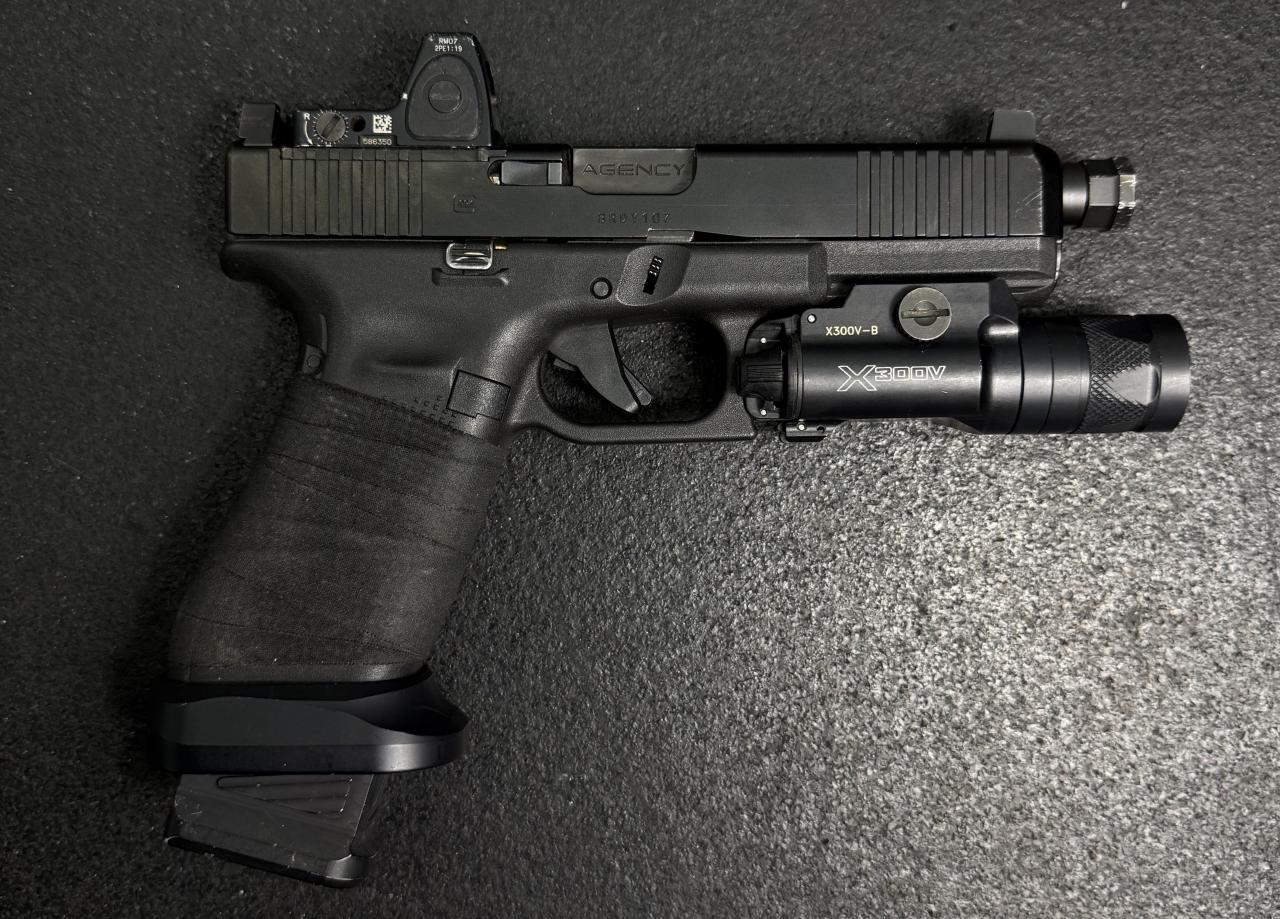
I picked a Glock 17 Gen 5 MOS.
I picked it because everyone who is serious about pistol work knows what the Glock 17 is — the most-shot, most-tested, most-proven, most-replicated pistol design of the last forty years. Glock did not invent the polymer-framed striker-fired pistol. They just made the one that worked the best, in the most conditions, for the most people, with the lowest training overhead. The Gen 5 MOS is the same gun with a few decades of refinement and a milled slide ready for a red dot.
It is nothing special. That is the entire point. When you spend your professional life around firearms, the gun you choose for yourself is the one that disappears into the background — the one you do not have to think about. That is a Glock 17. Always has been.
This pistol has the highest round count of anything in the safe. Two recoil spring assemblies and one barrel later, it is still going. I do not track an exact number anymore — the count was useful when it mattered for break-in and warranty, and the gun is so far past either of those that the number is just trivia.
What matters is what that round count buys you. Familiarity. Real, drilled-in, body-knows-it familiarity. Every reload is the same. Every grip is the same. Every trigger press is the same. The pistol has the same impulse on every shot, the same recoil pattern, the same return-to-zero — because I have shot enough through it that there are no surprises left.
Inside ten yards, focusing on aiming is honestly no longer required. The pistol comes up, the front-back alignment is established somewhere below conscious attention, and the rounds go where they need to go. That is not a brag. That is just what tens of thousands of rounds gets you. Anyone who runs one pistol that long will get there. Most people do not, because they jump platforms.
This is why the gun matters more than its specs sheet. The most expensive pistol in the safe loses to the cheapest one you have shot a hundred thousand rounds through. Round count compounds. Familiarity compounds. The Glock got there first because it got picked first, and it has stayed there because it works.
The optic is a Trijicon RMR Type 2 with a 3.5 MOA dot, mounted on the factory Glock MOS plate.
The RMR Type 2 needs no introduction. It is the duty-grade red dot that everyone else gets compared to. The Type 2 fixed the early electronics issues from the original RMR — true LED, properly waterproof, runs forever on a CR2032, and the housing is forged aluminum that takes the kind of abuse that kills cheaper dots. 3.5 MOA is the right size for a duty pistol — small enough for precision past 25 yards, big enough to find quickly inside ten.
Now, the honest part. It is sitting on the factory Glock MOS plate, and the factory MOS plate is not the best mounting solution for an RMR. Forward Controls Design makes a plate that drops the dot lower, locks tighter, and is genuinely worth the money. I will eventually swap.
I have not, because the gun is zeroed and I have been lazy. Re-zeroing means a session at the range, time I have not carved out, and the factory plate has held zero through more rounds than I want to count. Is the Forward Controls plate better? Yes. Does the factory plate work? Also yes. The honest answer about a build that runs is sometimes “it is not the best, but I have not fixed it because I have not needed to.”
The trigger is the Glock Performance Trigger — Glock’s recent factory upgrade. It is genuinely better than the stock Glock trigger. Cleaner break, slightly less pre-travel, better reset feel. It is not an aftermarket trigger and it is not pretending to be — but for the Gen 5 platform, it is the meaningful upgrade Glock should have shipped years ago, and it is what I would put on any duty Glock today.
The sights are Trijicon suppressor-height tritium night sights. Suppressor-height because they need to clear the RMR — co-witness with the dot when the dot is on, full sight picture when the dot is off or the battery is dead. Tritium because if the gun gets pulled in low light, you need to see the front sight without thinking. Trijicon makes these correctly and they last.
The point of running both is redundancy. The dot is the primary — faster, more accurate, and what you train to. But dots fail. Batteries die. Glass cracks. When that happens, you need iron sights you can use immediately, no apology, no transition. Suppressor-height nights give you that. They are insurance you hope you never collect on.
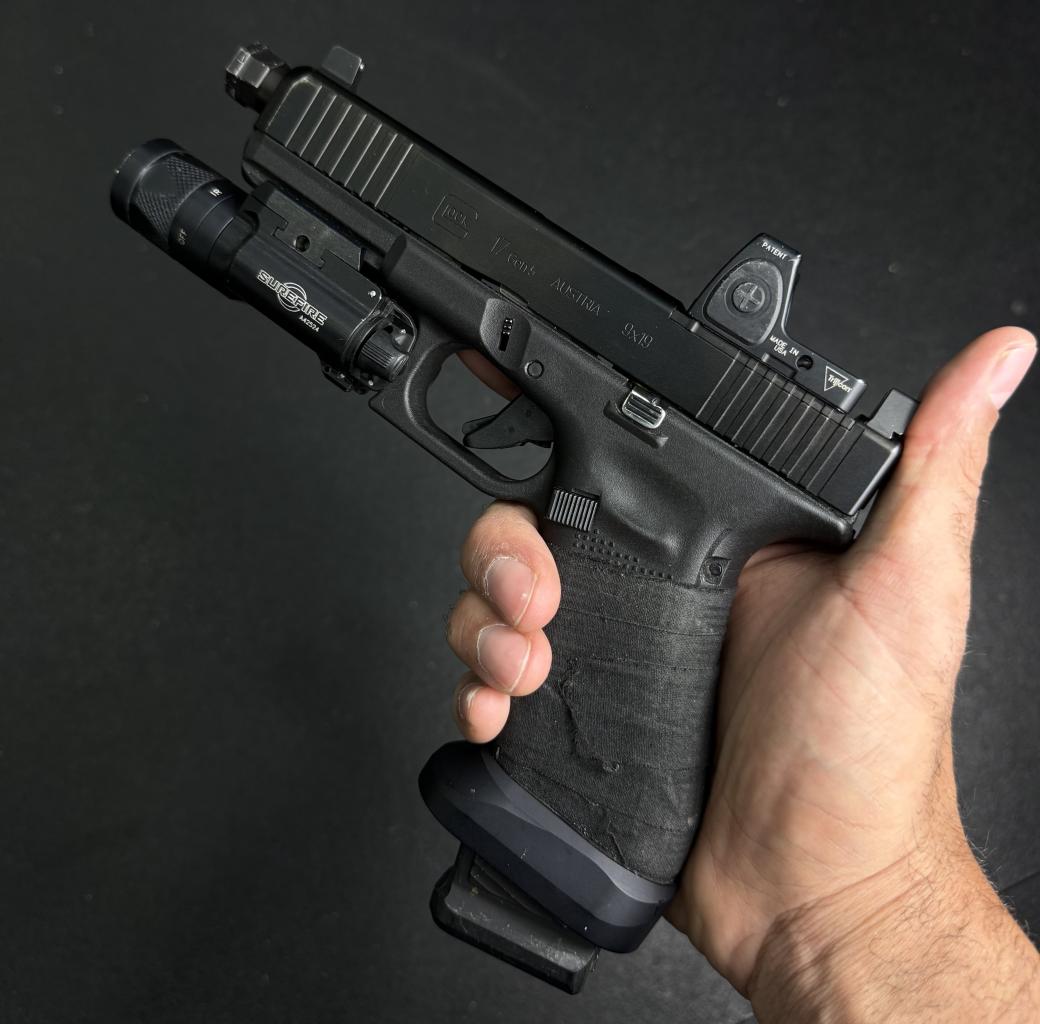
The magwell is a Taran Tactical. Big, beveled, polymer-coated funnel that catches a magazine and feeds it into the gun without you having to look at what you are doing. Reload speed under stress is about geometry — if the magazine has to find the well, you have already lost time. The TTI magwell removes that variable.
Magazines run ZEV +5 baseplates. Stock 17-round Glock mags become 22-round mags, which matters more than people think — fewer reloads in a string, more rounds available before the slide locks back, and the +5 floor plates index into the magwell exactly the way a stock floor plate does, just with five more rounds available. ZEV makes them right and they have lived through the same round count as the gun.
And the grip is wrapped in genuine hockey tape — actual cloth hockey tape, ordered from Amazon many moons ago, applied with no skill and no plan. It works. The texture under the hand is grippy, predictable, and replaceable when it gets ratty. Is there a fancier grip solution? Probably. Talon grips, stippling, custom epoxy, agency stippling jobs. None of that is a meaningful upgrade over hockey tape on a gun that already shoots well, and I have not bothered with any of it.
This is the thread on this whole pistol: simple solutions, that work, that I have stopped thinking about. None of these accessories cost real money, none of them require maintenance, and all of them just work.
The light is a SureFire X300V — the Vampire variant of the X300 line. White light up front, infrared LED for use with night vision. The white light is the standard SureFire X300 output — bright, throws far, and is the duty-light standard for a reason.
I have never used the IR feature in anything resembling a real situation. I have it because it is fun to have, and because if I am ever in a position where I need IR illumination on the pistol for a NV-equipped optic, I want to have already had it on the gun for years instead of trying to figure it out under stress. It is an option, not a feature I rely on.
The X300 platform itself is exactly what you want on a duty Glock — locked rail interface, ambidextrous switch, runs on CR123s that are dirt cheap and last forever, and it has been the carry-light standard for the better part of two decades for a reason.
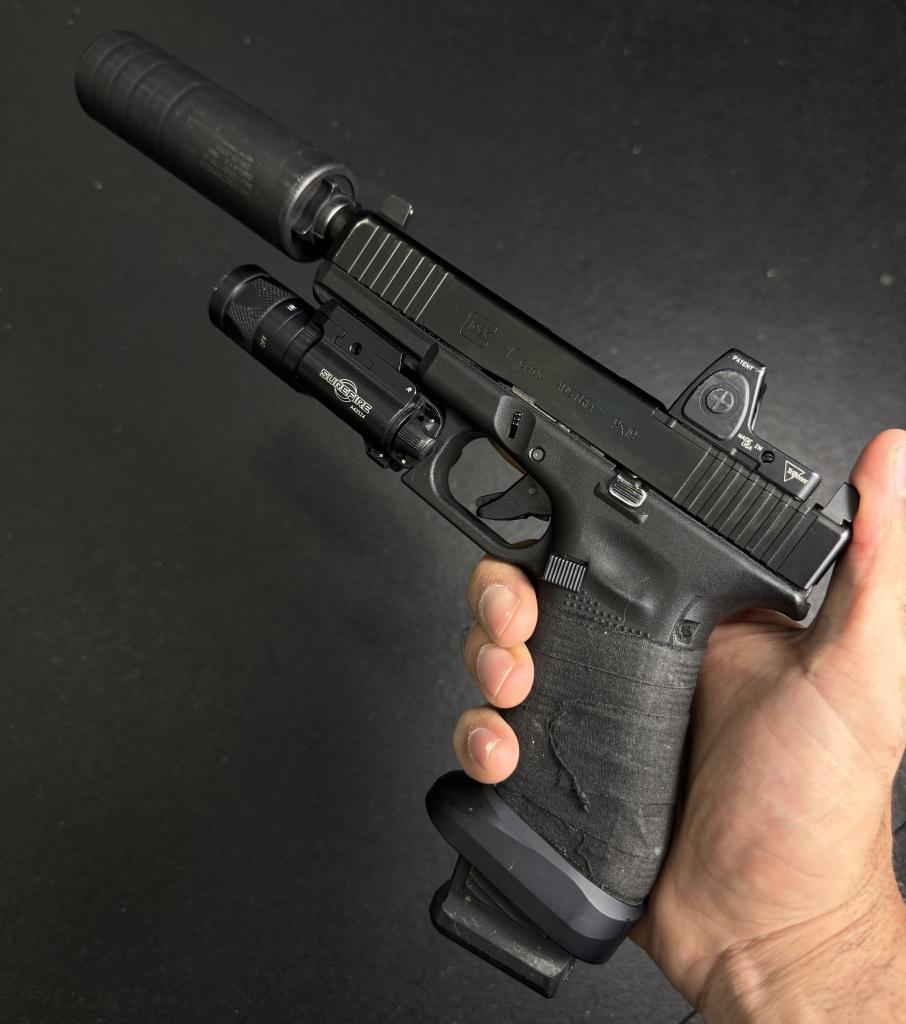
The barrel is an Agency Arms threaded barrel. Match-grade, 1/2x28 threaded muzzle, drop-in replacement for the factory 17 barrel. Aesthetically nice. Mechanically — fine. The factory Glock barrel was already accurate enough for what I do with this pistol; the Agency replacement is a marginal accuracy upgrade, and a meaningful upgrade in the option to thread on a suppressor when I want to.
Here is the honest take on suppressed Glocks: it is a gimmick for me. Glocks are not designed to be suppressed. The locked-breech tilting-barrel action does not tolerate a fixed muzzle device the way a fixed-barrel design does — you need a Nielsen device booster on the rear of the can to compensate for the added mass on the barrel and let the gun cycle properly. With the booster, it works, but it is still not as reliable as the same gun bare. The gas blowback into the shooter’s face is significantly worse than on a designed-suppressed platform like the MP9. The cycle gets fussy with subsonic ammunition.
It is fun to shoot. It is not a serious carry configuration. I have a suppressor I can put on this pistol when a client asks to shoot a suppressed handgun, or when I want to send a fun string at the range. That is it. The threaded barrel is a feature I use maybe once a quarter, and the only reason it is on the gun at all is that I had the option, the licensing, and the slide off for other reasons when I installed it. Now I have the capability without thinking about it.
| Component | Glock 17 Gen 5 MOS |
|---|---|
| Platform | Glock 17 Gen 5 MOS |
| Caliber | 9x19mm Parabellum |
| Capacity | 17+1 Standard — 22+1 with ZEV +5 |
| Optic | Trijicon RMR Type 2 — 3.5 MOA |
| Optic Plate | Factory Glock MOS (Forward Controls Design eventually) |
| Sights | Trijicon Suppressor-Height Tritium Night Sights |
| Trigger | Glock Performance Trigger |
| Barrel | Agency Arms Threaded — 1/2x28 |
| Magwell | Taran Tactical |
| Magazine Extensions | ZEV +5 Baseplates |
| Light | SureFire X300V Vampire — White + IR |
| Grip Treatment | Genuine Hockey Tape |
| Status | Highest Round Count in the Safe — 2 Guide Rods, 1 Barrel Replaced |
The market is moving fast. Custom 2011s from Staccato, Atlas, Phoenix Trinity, and a half-dozen smaller shops are pushing well into the $10,000 range and finding buyers for every one they build. Striker-fired platforms are getting better triggers, better optic interfaces, better grip ergonomics, and tighter tolerances every year. There is more genuinely good pistol engineering being shipped right now than at any point I can remember, and a lot of it is impressive work.
For me, none of it matters. The Glock 17 is familiar. It works. Every reload is the same as the last one. Every recoil impulse is the same. Every grip pickup is muscle memory I do not have to think about. There is no upgrade path that gives me back the years and the round count I have already invested in this gun, and there is no pistol on the market — at any price point — that is going to outperform a hundred thousand rounds of trigger time.
I could care less about making the jump at this point in time. Maybe in ten years. Maybe never. The Glock works, and the round count keeps climbing. That is enough.
SUN: BY APPT.
MON-TUES: 12PM - 6PM
WED-FRI: 10AM - 6PM
SAT: 10AM - 3PM