Issued for a Reason
The URGI — formally URG-I, Upper Receiver Group – Improved — is the M4A1 upper that USSOCOM adopted around 2018 to replace the older SOPMOD Block 2 configuration. It was the result of the SOCOM URG-I program — a competitive procurement that pulled the best parts from multiple top-tier manufacturers to address the specific shortcomings operators kept hitting with the old setup: barrel longevity, gas system harshness, rail rigidity, and integration with modern accessories. SOCOM does not pick lightly. The URGI was the answer they landed on after extensive testing across the spectrum of SOCOM units, and it has been the standard SOCOM 5.56 carbine ever since.
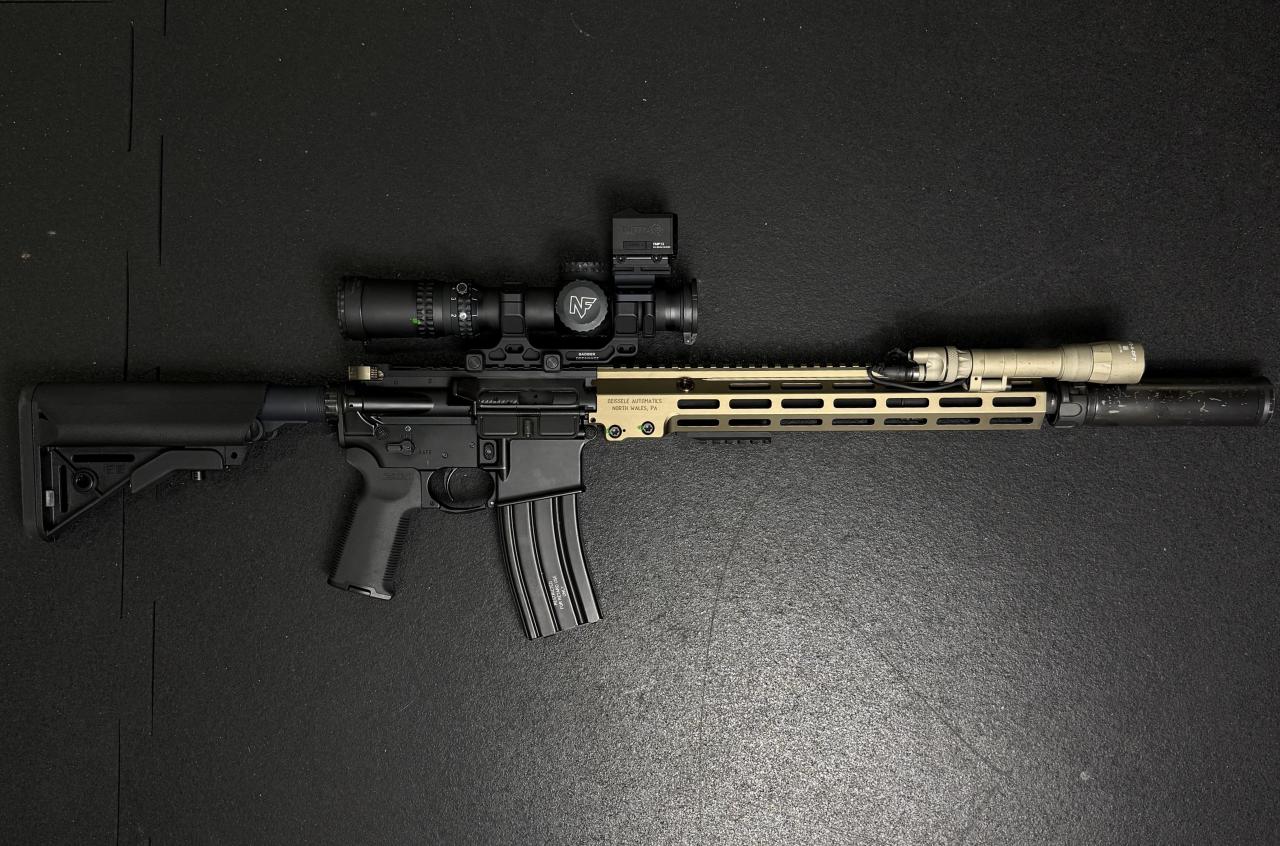
What makes it different from a regular M4A1? Three things: a 14.5-inch cold hammer forged barrel rated for an order of magnitude more rounds than a chrome-lined chamber barrel, a mid-length gas system instead of carbine length, and the Geissele Super Modular Rail MK16 in 13.5-inch length — the handguard SOCOM selected for the program, finished here in DDC (Desert Dirt Color). None of those decisions are revolutionary on their own. The combination is what makes the URGI special — and what makes it the rifle I reach for before anything else in the safe.
This is my number one. Not because it is the fanciest rifle I own, not because it is the most expensive, and not because it has the most accessories bolted to it. It is number one because it is honestly the most capable, all-around, do-everything 5.56 rifle on the market. It runs forever. It shoots better than people expect. It reaches out past 600 meters with quality ammo. And there is nothing it does poorly. That is what number one looks like.
The full-auto configuration of the rifle in this article is a properly registered NFA item, lawfully held by Vantage Defense under FFL Type 07 / SOT Class 2. Manufacturing or possessing an unregistered machinegun is a federal felony under 18 U.S.C. § 922(o):
- Up to 10 years in federal prison
- Up to $250,000 in fines
- Lifetime loss of all firearm rights
- The ATF prosecutes these cases aggressively — do not do this without proper licensing.
Three engineering decisions define the URGI and they all work together. Pull any one of them out and the rifle is just another carbine. Together, they are the platform.
The barrel. The URGI runs a 14.5-inch cold hammer forged barrel, and that single decision is the largest reason this rifle is in service. CHF barrels are 20,000+ rounds capable — meaningfully longer than a standard chromed chamber barrel and dramatically longer than a button-rifled barrel. Hard chrome lining inside, double the lifespan of typical carbine barrels, and a 1:7 twist rate that fully stabilizes the heavy 5.56 projectiles — 77 grain OTM, 75 grain TAP, and similar — that actually reach out and do work at distance. This is not a rifle that wears out. You will run out of money for ammunition before you wear out a URGI barrel.
The gas system. The URGI uses a mid-length gas system instead of the carbine length on the standard M4. Mid-length sits roughly two inches farther forward on the barrel, and that change matters: longer dwell time means more complete propellant burn before the bolt unlocks, lower bolt carrier velocity, less violent unlock, less battered parts, less felt recoil, softer follow-up shots, and a flat shooting impulse that lets you stay on the dot. The URGI is just nicer to shoot. That sounds soft until you have run a hard string and your eyes are still tracking through it.
The rail. The handguard is a Geissele Super Modular Rail MK16 in 13.5-inch length, finished in DDC (Desert Dirt Color) — the rail SOCOM actually selected for the URG-I program after running it against the field. The MK16 uses a barrel nut clamp interface, which is the standard mounting method for free-float rails — but Geissele’s implementation is engineered to a rigidity standard that competes with proprietary integrated systems. The barrel nut and clamp geometry minimize flex under sling tension, bipod pressure, and accessory load. M-LOK throughout, lightweight aluminum hardcoat anodized construction, and an accessory footprint that does not fight you when you start mounting lights, lasers, bipods, and offset thermals. This is the SOCOM-spec rail, in the SOCOM-spec finish. It is not a clone — it is the part SOCOM picked, sold off the same line that fills their contracts.
The trigger is a Geissele Super Select Fire (SSF) — a two-stage trigger purpose-built for select-fire lower receivers. Geissele’s reputation does not need defending. The SSF gives you a definitive first stage to prep against, a clean break with no creep at the wall, and a short positive reset. Build quality is what you would expect from Geissele — mil-spec hardness, hardened pins, designed to take abuse and keep going.
In semi, it shoots like one of the best AR triggers you can buy. In full auto, the geometry is engineered specifically to handle the auto-sear interface cleanly — you do not get the trigger reset weirdness that plagues some FA-compatible triggers in the lower price tiers. It is not the cheapest trigger you can put in a fighting rifle. It is the right one, if permitted.
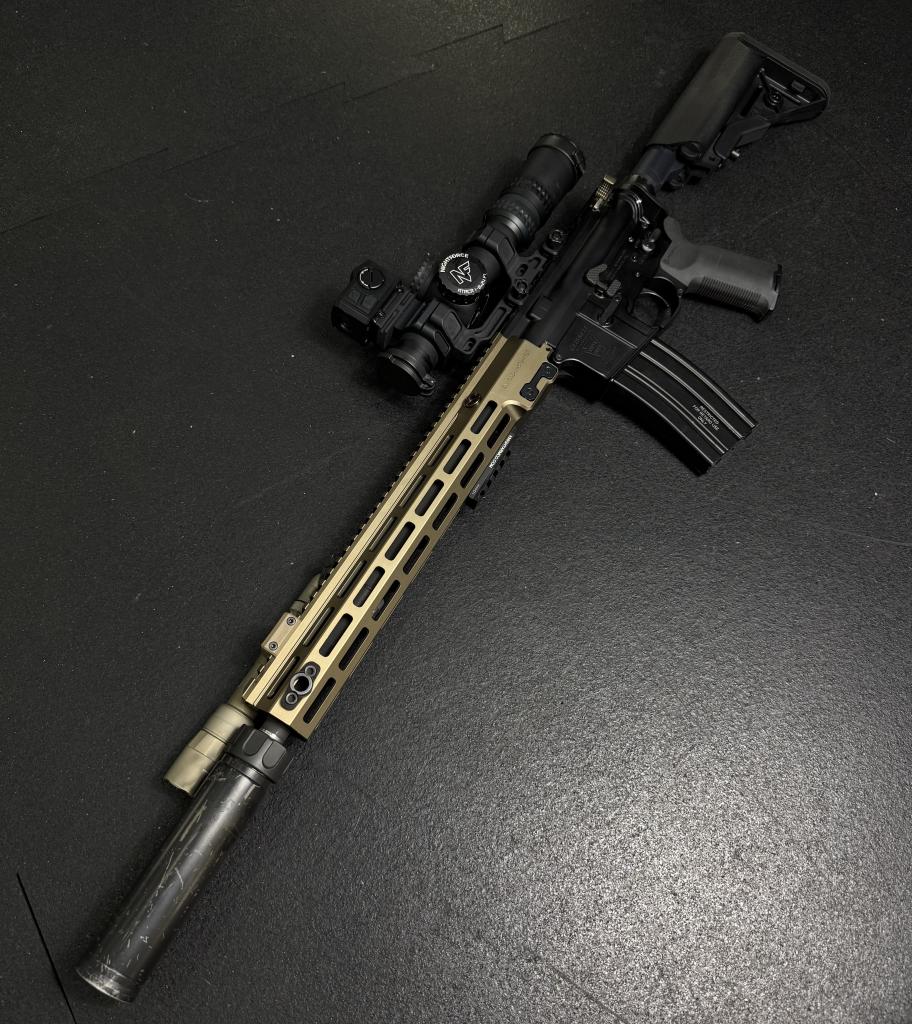
The day optic is a Nightforce ATACR 1-8x F1 sitting on a Badger Ordnance Condition One mount at 1.70-inch height.
The ATACR 1-8 is the standard against which other LPVOs are measured for serious fighting rifle work. Nightforce glass at this caliber is among the best in the world — daylight-bright illumination that you can actually see in full sun, a true 1x at the bottom end with no fishbowl distortion, and clean 8x at the top end that gives you all the magnification you need to use the URGI’s reach. The reticle is first focal plane, which means your subtension marks scale with magnification — whatever value the reticle shows at 8x, it shows the same value at any other power, just sized differently. For a fighting LPVO that has to handle close-range bursts and extended-range precision in the same string, FFP is the right answer.
The Badger Ordnance Condition One is what mounts a Nightforce. Period. The 1.70-inch height puts the optic at the natural cheek weld position for an upright shooting stance — you are not hunting for the eyebox, you are not craning your neck. Badger machines to tolerances most mount makers do not even claim to hit, and once you torque a Badger down on a rail it does not shift. Ever. I have run this exact mount through thousands of rounds of full-auto and it has never moved off zero by a measurable amount.
This is where it gets interesting and where I have to be honest about a real limitation.
The thermal is an Infitac FMP-13 mounted on a 12-O'clock RMR mount, set up at 45 degrees off the day optic. Slight Adjustment to view the screen, you're there. Roll your eyes back and you are on the ATACR. Fast, simple, no swapping optics in the dark and no breaking your firing position to switch capabilities.
When the Infitac works, it works well. I have hit targets out to 350 yards with this thermal — respectable for a fairly priced compact thermal in this size class. Heat signatures pop against any cooler background. You see through smoke, fog, and total darkness. There is no ambient light requirement at all. For night work in cold weather, where animals and people stand out hard against the cold environment, this is an enormous capability multiplier on a fighting rifle.
But there is one major flaw, and you need to know about it before you trust this optic for anything serious. The battery life atrocious. In cold weather — below about 30 degrees Fahrenheit — this thermal lasts roughly 25 minutes on a single battery. In normal conditions you get maybe 2 hours, max. That is the cost of running a compact thermal at this price tier. The bigger, more expensive thermals do significantly better. The compact ones do not.
This is why the buttstock is loaded with backups. The B5 stock’s cheek pouch is packed with fresh batteries because if you actually want to use the thermal in any extended capacity, you are going to be swapping batteries multiple times in a single session. Plan for it. Pack twice as many spares as you think you need. This is not a flaw I can engineer around — it is a flaw I can only prepare for.
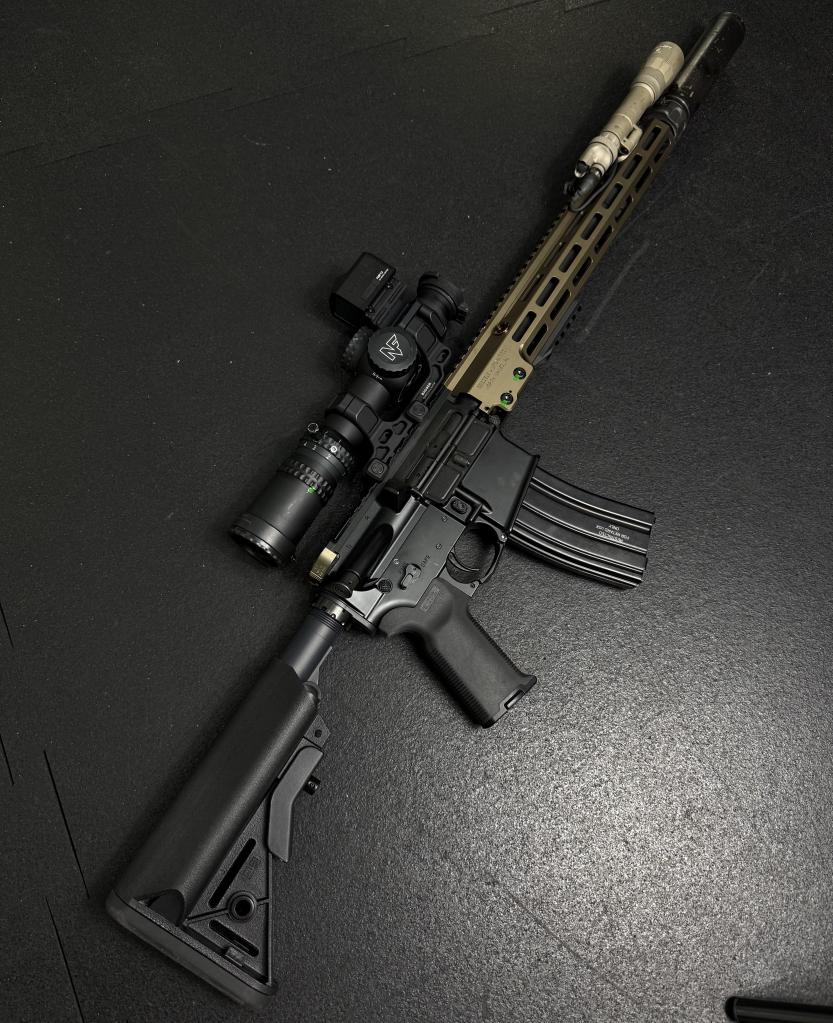
The muzzle device is a SureFire 4-prong flash hider — the classic SOCOM piece that doubles as the suppressor mount. The 4-prong design suppresses muzzle flash visible to the shooter and to the sides, and it provides the rock-solid host interface for the SureFire suppressor lineup. There is a reason this design has been on SOCOM rifles for the better part of two decades. It works.
The can is a SureFire SOCOM RC3 — the third-generation 5.56 SOCOM rapid-attach suppressor. Lighter than the older SOCOM cans, hard-use rated, and engineered to handle full-auto fire from a 14.5-inch rifle without melting itself or the rifle’s gas system. If the suppressor on your rifle is not built for the work you would actually do with the rifle, you have the wrong suppressor. The RC3 is built for it.
The light is a SureFire M640 Turbo Scout — the high-candela tight-beam version of the M640. 65,000 candela of throw, narrow beam profile, built for distance ID rather than close-range flood. On a 14.5-inch fighting rifle that may need to identify a target at 300+ yards in the dark, the Turbo throws light where you need it. The same light is on every serious rifle I run, and there is no good argument against it.
Wired into the rail is a Unity Tactical Mod Button — an aftermarket pressure switch that replaces the SureFire factory tape switch. The Mod Button is engineered better in every measurable way: more tactile feedback, more durable construction, more resistant to accidental activation, and easier to actuate cleanly under stress. Unity Tactical builds the gold standard of pressure switches, and the Mod Button is the right call on any rifle where light operation actually matters.
People underestimate what a 14.5-inch 5.56 can do at distance. The bar-talk myth is that 5.56 falls off a cliff past 300-400 yards. That has not been true for a long time, and it is definitely not true with the URGI configuration.
With the right ammunition — 77 grain OTM or similar heavy match-grade projectiles — this rifle is comfortably effective past 600 meters. The combination of the cold hammer forged barrel, the 1:7 twist rate that fully stabilizes heavy projectiles, the Nightforce ATACR at 8x that lets you actually see and engage at distance, and the rigid MK16 rail that holds zero through any pressure all add up to a rifle that genuinely shoots beyond what most people think a 5.56 carbine can shoot.
This is what cements the URGI as my number one rifle, all things considered. Most fighting rifles — even very good ones — get reach-limited inside 400 meters. The URGI extends that. You can still take a 50-yard shot with the same rifle, with the same ammunition, with no swap and no compromise. That is the definition of a complete fighting rifle — one that does not force you to choose between close-range capability and reach. The URGI does both, and it does both well.
| Component | 14.5″ URGI |
|---|---|
| Platform | 14.5″ URGI — SOCOM-Spec Upper Receiver Group |
| Configuration | Full-Auto — NFA Registered |
| Caliber | 5.56x45mm NATO |
| Barrel | 14.5″ Cold Hammer Forged — 1:7 Twist, Hard Chrome Lined |
| Gas System | Mid-Length |
| Handguard | Geissele Super Modular Rail MK16 — 13.5″ M-LOK, DDC |
| Trigger | Geissele Super Select Fire (SSF) |
| Stock | B5 Systems |
| Day Optic | Nightforce ATACR 1-8x F1 |
| Day Optic Mount | Badger Ordnance Condition One — 1.70″ Height |
| Thermal Optic | Infitac FMP-13 |
| Thermal Mount | Badger 12 O'Clock RMR Footprint |
| Light | SureFire M640 Turbo Scout — 65,000 Candela |
| Switch | Unity Tactical Mod Button |
| Muzzle Device | SureFire 4-Prong Flash Hider |
| Suppressor | SureFire SOCOM RC3 |
| Effective Range | 600+ meters with 77gr OTM |
| Licensing Authority | Vantage Defense — FFL Type 07 / SOT Class 2 |
SUN: BY APPT.
MON-TUES: 12PM - 6PM
WED-FRI: 10AM - 6PM
SAT: 10AM - 3PM