Rifle Scopes 101
Brandon Johnson Apr 27, 2026
Rifle Scopes 101
Your rifle scope is the most important component on your rifle, full stop. The barrel, action, trigger, stock — all of it matters less than what sits on top. A great scope on a budget rifle is forgivable. A budget scope on a great rifle is a waste of both. The whole point of a precision rifle is to put a bullet exactly where you intend, and the scope is the part of the system that tells you where that is.
Most shooters know they should spend money on glass. Fewer know what they’re actually paying for. Even fewer can explain why a $3,000 Nightforce is meaningfully different from a $400 hunting scope when both magnify the same target the same amount. This guide unpacks all of that — what makes a scope good, what makes one great, where the marginal dollar is actually buying something, and the optics we trust on our own rifles.
The Three Things That Matter
Strip away the marketing and there are three pillars of a quality rifle scope: glass, tracking, and build. Everything else — reticle options, illumination, parallax, throw levers, fancy turret indicators — is downstream of these three. If a scope nails the fundamentals, the features make it better. If it misses on any of them, no feature list saves it.
- Glass. The lenses, coatings, and optical prescription that determine what you see through the scope — clarity, color, contrast, brightness, and resolution.
- Tracking. When you turn the elevation turret 5 MILs up, does the bullet impact go up exactly 5 MILs — every time? When you spin it back to zero, are you actually back at zero? This is what separates a scope you can dial with confidence from one that costs you matches.
- Build. The chassis, seals, anodizing, and internal components that determine whether the scope holds up to recoil, drops, weather, and time. A precision scope that loses zero after a hard transport is a paperweight.
What $$$ Buys You
Below about $400, you’re buying a scope that’ll work fine in good light at moderate distance and may or may not track reliably. Around $1,000 you start getting honest tracking and ED glass. Above $2,000 you’re buying the top tier of glass, tracking that’s tested to thousandths of a MIL, and a chassis that’s been beaten to confirm it survives. Here’s the rough breakdown:
- Acceptable glass in daylight
- Tracking usually fine for hunting distances
- Coatings adequate, edges may distort
- Light transmission ~80%
- SFP common, FFP available
- ED or HD glass starts here
- Tracking holds up across the dial
- Real edge-to-edge clarity
- Light transmission ~90%
- FFP standard, mil/MOA reticles
- Top-tier glass and coatings
- Tracking validated to 0.05% or better
- Mil-issue chassis durability
- Light transmission 92–95%+
- ZeroStop, ZeroLock, premium reticles
Diminishing returns are real. The jump from $400 to $1,200 is enormous. The jump from $1,200 to $2,500 is real but smaller. The jump from $2,500 to $5,000 mostly buys consistency under harder use, niche reticle options, and brand reputation. Where the marginal dollar stops earning its keep depends on what you’re asking the scope to do.
The Glass: What You're Actually Paying For
“Better glass” is one of the most overused phrases in firearms marketing. Here’s what it actually means:
ED / HD glass. Extra-low Dispersion (Nightforce) or High Density (Leupold) glass uses different lens materials to reduce chromatic aberration — that color-fringing halo around high-contrast edges. Cheap scopes show purple/green fringing on a black target against snow. Quality glass doesn’t.
Multi-coatings. Every air-to-glass surface in a scope reflects a small amount of light. A scope might have 8–12 lens elements, meaning 16–24 surfaces. Anti-reflective coatings reduce that loss. “Fully multi-coated” means every surface gets multiple coating layers, which is the only acceptable answer for a serious scope. Cheaper scopes are “multi-coated” (some surfaces) or “coated” (single layer on outside surfaces only) and lose dramatic amounts of light.
Light transmission. Premium scopes hit 92–95%+. Mid-tier hits 88–90%. Budget scopes drop to 80% or lower. That 10% gap doesn’t matter at noon — it matters at dusk when you’re trying to identify a target inside a tree line and the cheap scope has already gone dark.
Edge-to-edge clarity. Cheap scopes are sharp in the middle and soft at the edges. That doesn’t matter when you’re looking through the center, but the moment your eye drifts — tracking a moving target, scanning — the soft edges cost you. Premium scopes hold sharpness across the full lens.
Color rendition and contrast. Quality glass shows a target as it actually looks. Lesser glass introduces a yellow, green, or blue cast and flattens contrast. You don’t notice this looking through one scope. You notice it instantly comparing two side by side at the range.
“Cheap scopes do fine until they don’t. Quality glass does fine, then keeps doing fine in mirage, dusk, snow, glare, and rain.”
Tracking: The Quiet Hero
You can pick a scope by glass alone and end up with a beautiful image attached to a turret that doesn’t actually move the bullet where you tell it to. That’s how shooters end up convinced their rifle is inaccurate when the truth is that their scope dialed 4.7 MILs when the dial said 5.0.
Good tracking means three things: accurate clicks (each click is exactly the value claimed), repeatable returns (going up 5 MILs and back down lands at the same point of impact you started with), and linear behavior (a 5 MIL dial moves the impact 5 MILs whether you’re at the bottom of the elevation range or near the top).
The cheap test for tracking is the tall target / box drill. Print a target with measured marks at known distances above and beside the bull. Shoot a group at the bull, dial up a known amount, shoot a group at the next mark, dial right, and so on around the box. If the groups land where the math says they should and you return to a tight group at the bull, your scope tracks. If anything is off, you have a problem.
FFP vs SFP: Which Plane You Pick Matters
The reticle in any scope sits on one of two focal planes. This is one of the most consequential choices in the whole purchase, and it’s frequently misunderstood.
First Focal Plane
FFP · The reticle scales with magnification- Holdover and ranging marks accurate at every magnification
- Works for ranging targets at any power
- Reticle can look thin at low magnification
- Reticle can dominate at max magnification
- Standard for tactical, PRS, and long-range
- Always more expensive to manufacture
Second Focal Plane
SFP · The reticle stays a fixed size- Holdovers only accurate at one magnification (usually max)
- Reticle visible and consistent at all powers
- Often a slimmer, hunting-style crosshair
- Cheaper to produce, lighter typically
- Standard for hunting and casual use
- Fine if you don’t plan to dial or hold
If you’ll dial elevation for distance and use the reticle to hold for wind or movers, get FFP. If you sight in at one distance, hunt at moderate range, and rarely change power, SFP is fine and saves money. The vast majority of long-range, tactical, and competition shooters run FFP for one reason: the marks always mean what they’re supposed to mean.
Reticles: The Christmas Tree Question
Once you’ve committed to FFP, the reticle question opens up. You can run a simple plex, a duplex, a basic mil-dot, or you can run a full grid — what shooters call a “Christmas tree” reticle. The grid extends below center and out to the sides, giving you precise hold marks for any combination of bullet drop and wind without ever touching the turret.
The two grids that matter are the Horus Tremor3 and the Horus H59. Tremor3 is the more aggressive grid — finer subtensions, more wind dots, ranging features built in. H59 is cleaner: same Christmas tree concept, fewer numbers and ticks, easier to read at speed. Both work. The right answer depends on you.
We run the Tremor3. It’s busy — we’re not going to pretend otherwise — but once you’ve trained on it, the data density pays off. That said, for plenty of shooters, the Tremor3 is too much. The H59 (or any clean Christmas tree variant) gives you the same hold-fast, no-dial speed advantage with half the visual noise. The non-negotiable is the tree itself. If your reticle has just a center crosshair and stadia marks, you’re leaving speed and precision on the table. Get something with grid hold capability.
Our Two Favorites
The market is full of capable scopes. Schmidt & Bender, Tangent Theta, Vortex Razor, ZCO, Kahles — all earn respect. For what we recommend and run on our own rifles, two stand out for two different missions.
Nightforce ATACR 4-16x42 F1
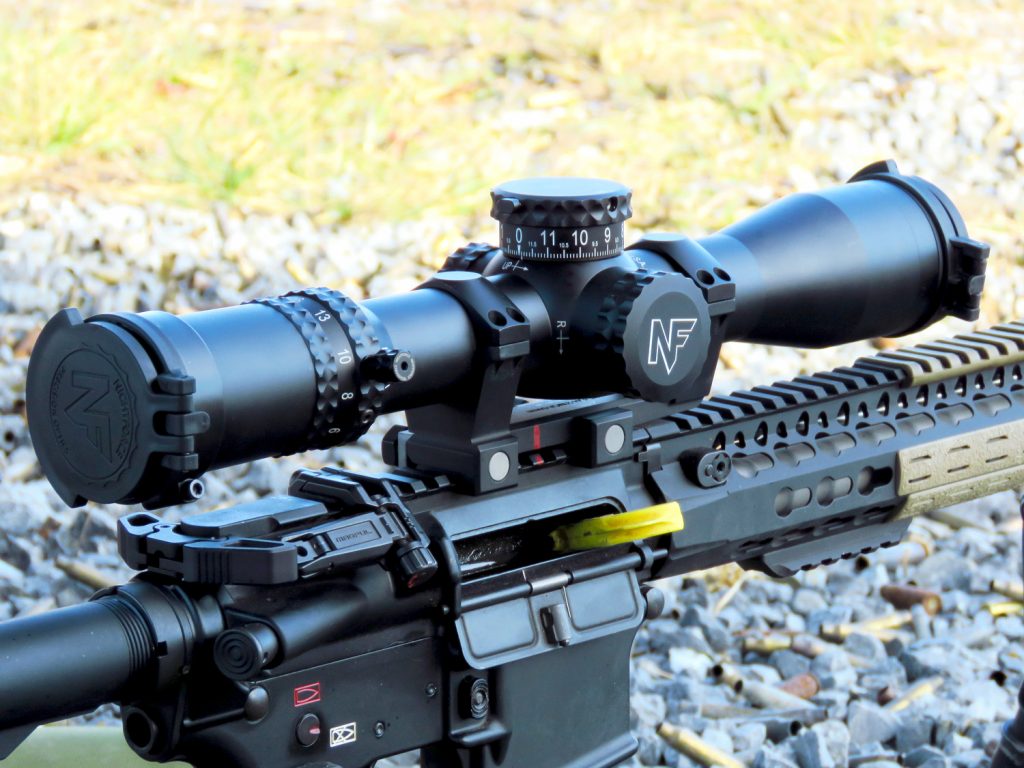
The ATACR 4-16x42 F1 is the scope that wins when weight, length, and toughness matter as much as glass. At 12.6 inches and just over 30 ounces, it lives equally well on a bolt gun, a gas-gun SPR, or an AR-10 platform. The 4–16x range is genuinely useful from inside 100 yards out past 1,000, without forcing you to live at one end of the magnification dial.
The ZeroHold elevation turret combines the speed of an exposed turret with a physical zero stop and an additional 2 MILs of downward travel for POI shifts — a practical detail that competition shooters appreciate. The capped windage turret stays out of the way until you need it. ED glass and Nightforce’s coatings deliver image quality that holds up against scopes priced significantly higher. The DigIllum system gives you red or green reticle illumination at the press of a button. Reticle options include the MIL-XT, MIL-R, MOAR, and Tremor3.
Best for: Compact precision rifles, gas guns where weight matters, shooters who want one scope that works from CQB-ish distances out to 1,000+ yards.
Leupold Mark 5HD 3.6-18x44
The 5-25x56 Mark 5HD gets all the press, but for most shooters — including most of our customers — it’s more glass than the rifle ever needs. The 3.6-18x44 is the version we actually recommend. The 3.6x bottom end is fast and forgiving for closer work. The 18x top end will cleanly take you out to 1,000 yards. The smaller 44mm objective and shorter overall length save weight, save mounting height, and make the scope feel like part of the rifle instead of a satellite dish bolted to it.
The same M5C3 ZeroLock turret system shows up here that we love on its bigger sibling — in our opinion, the best elevation turret on the market. Each revolution is visually and tactilely indicated, ZeroLock prevents accidental dial movement, ZeroStop returns you to zero with confidence. 30 MILs of total elevation in three full revolutions handles anything inside its stated range. The Twilight Max HD lens system squeezes light at dawn and dusk — Leupold’s low-light performance is a known advantage. Reticle options include the TMR, PR1-MIL, PR2-MIL, H59, CCH, and Tremor3 — the full Christmas-tree menu. Built in Beaverton, Oregon with a lifetime warranty.
Best for: Precision bolt guns, hunting rifles that double as long-range platforms, anyone who wants the best turret in the industry without the size, weight, and overkill of a 5-25x56.
The 5-25x56 is a phenomenal scope. It’s also a lot of glass, a lot of weight, and a lot of magnification you’ll only use if you’re actually shooting past 1,200 yards on the regular. Most shooters aren’t. The 3.6-18 covers what the average precision rifle gets used for — comfortable to 1,000 yards, fast on closer targets, lighter on the gun. Save the 5-25 budget for when you have a dedicated extreme long-range rifle that justifies it.
The Mount Is Not Optional
You can buy the finest scope in the world, slap it in a $40 set of rings, and you have effectively wasted your money. The mount is what holds your zero. The mount is what survives recoil. The mount is what either keeps the scope tube straight and unstressed or torques it into a slight bind that ruins tracking. This is not a place to save money.
Why We Run the Badger Condition One
Badger Ordnance has been making precision mounts for the military and law enforcement market since the early 1990s. Their original Unimounts were selected for the U.S. Army Precision Sniper Rifle program and their DMR rings have been issued on the USMC DMR platform for years. That heritage matters — but for our money, what makes the current Badger lineup the right choice is the Condition One (C1) system.
The Condition One is a one-piece, billet-machined scope mount that combines integrated recoil control with a modular accessory architecture. The base mount itself nails the fundamentals: 7075-T6 aluminum, Mil-Spec Type III hardcoat anodizing, integrated recoil lug that locks into the receiver’s recoil slot. Hand-fit, matched, serialized. Available in 30mm, 34mm, and 35mm tube diameters with multiple heights and 0 or 20 MOA cant options.
What sets the C1 apart from a traditional Unimount is the Accessory Ring Cap (ARC) system. The ring caps are the Badger replacement caps for the C1 mount that have integrated mounting points, allowing you to bolt accessories directly onto the rings without rail real estate or extra mounts. That opens up the rest of the system — including the two we run.
The 12 O’Clock Top (12TOP) Mount
The C1 12TOP is a small platform that mounts on top of the Condition One ARC at — you guessed it — the 12 o’clock position, putting a micro red dot directly above your scope tube. Available footprints fit the Trijicon RMR, Aimpoint ACRO, T2, and several other common micro red dots. The use case is simple: when a target presents itself inside scope minimums or you need to break to a closer shot fast, you tilt the rifle slightly forward and the red dot is right there, perfectly aligned with the bore. No offset 45-degree mount, no awkward head movement, no rail clutter.
For a rifle that lives at distance but occasionally needs to engage closer, the 12TOP is a meaningful upgrade. Cleaner than a 45-degree mount, faster than a quick-detach scope swap.
The C1 Anti-Cant Device (ACD)
The C1 ACD is Badger’s anti-cant device, designed to mount on any C1 mount in any of four orientations (left, right, fore, aft). It’s a leveling instrument — a bubble level for your scope — and it solves a real problem: at 600 yards a couple of degrees of cant moves your bullet several inches off your wind hold. At 1,000 yards it can put you off the target entirely. Eyes don’t naturally read level. The ACD does.
What makes Badger’s version different from a generic bubble level is the build. The level uses a 3/4-inch glass vial filled with a ceramic BB instead of an air bubble — ceramic responds faster across temperature and pressure changes, and it doesn’t freeze or sluggish in cold weather the way an air bubble can. The housing also accepts a tritium vial (procured separately) for low-light operation. 7075-T6 aluminum, hardcoat anodized, 0.63 oz total weight. Available in black or tan to match your build.
The system clicks together: C1 mount, ARC for accessory mounting, 12TOP for offset red dot, ACD for level. Each piece earns its place. None of it is unnecessary — and the modular approach means you build out only what you actually need.
Mount Buying Checklist
- Match the tube diameter exactly — 30mm, 34mm, or 35mm. No adapters or shims.
- Pick the right height for your rifle and objective — the bell shouldn’t kiss the barrel, your cheek weld should be natural.
- 20 MOA cant for long range — gives you back elevation travel for distance shooting.
- Use a torque wrench — ring screws are spec’d (usually 15–25 in-lbs). Hand-tight is wrong in both directions.
- Pick a one-piece mount when possible — the C1 or a unimount eliminates ring alignment issues entirely.
- Plan for accessories — if you’ll run a level or 12 o’clock red dot, pick a system like the Condition One that supports it natively.
Other Attachments Worth Buying
The scope itself is the start. The C1 ACD covers your level. Here’s the rest of the supporting cast that earns its place:
Throw lever (cattail). A short bar that extends off the magnification ring. Lets you change power one-handed without breaking position. Some scopes ship with one; others sell the matched lever as an accessory. If your scope didn’t include one, get one.
Honeycomb anti-reflection device (killflash). A honeycomb filter on the objective. Cuts the chance of a glint giving away your position and reduces glare from low sun. Tenebraex makes the standard, sized to your scope’s objective.
Flip-up scope covers. Tenebraex Tactical Tough caps are the standard. Cheap covers fail; nice covers don’t. The ATACR ships with these in the box, which is one reason we keep recommending it.
Sunshade. A short tube that extends from the objective. Reduces glare on bright days and keeps mirage off the front lens during direct sun. Cheap insurance.
Custom turret / drop chart. Some companies (Leupold’s CDS) build you a custom yardage-marked elevation dial for your specific rifle and ammo. Useful if you’re hunting and want to dial yardage instead of MILs.
ARCA / pic-rail bottom. Increasingly common on the rifle itself, not the scope, but it changes how the scope rides. ARCA dovetails let you slide the rifle on a tripod arca clamp without unbolting anything. If your bolt gun has it, use it.
Setup Notes Before You Mount
- Mount in matched-pair rings or a Unimount. No mismatched ring sets, no thrift-store specials.
- Torque to spec. Most rings are 15–25 in-lbs. Use a calibrated torque wrench, not a fingertight guess. Apply a drop of blue Loctite if your manufacturer recommends it.
- Level the reticle. A canted reticle multiplies error at distance. Use a reticle leveling tool or a precision square against the rail.
- Eye relief first, level second. Set scope position so it lands at full eye relief in your natural cheek weld, then level.
- Bore-sight before live fire. Start on paper at 25 yards, confirm at 100, then truth-test by dialing.
- Verify tracking. Run a tall target test before you trust the scope at distance. Twenty minutes at the range saves hours of confusion later.
Come Look Through One.
We stock the Nightforce ATACR lineup, the Leupold Mark 5HD across reticle and magnification options, Badger Ordnance Unimounts and rings, and the rifles to mount them on. Stop into our Woburn shop and put your eye behind the glass — the difference between reading specs and actually looking through a $2,500 scope is the entire point.
Shop Rifle Scopes
SUN: BY APPT.
MON-TUES: 12PM - 6PM
WED-FRI: 10AM - 6PM
SAT: 10AM - 3PM