
Weapon-Mounted Lights: Pros, Cons & Our Top Picks
Brandon Johnson May 14, 2026
Let There Be Light.
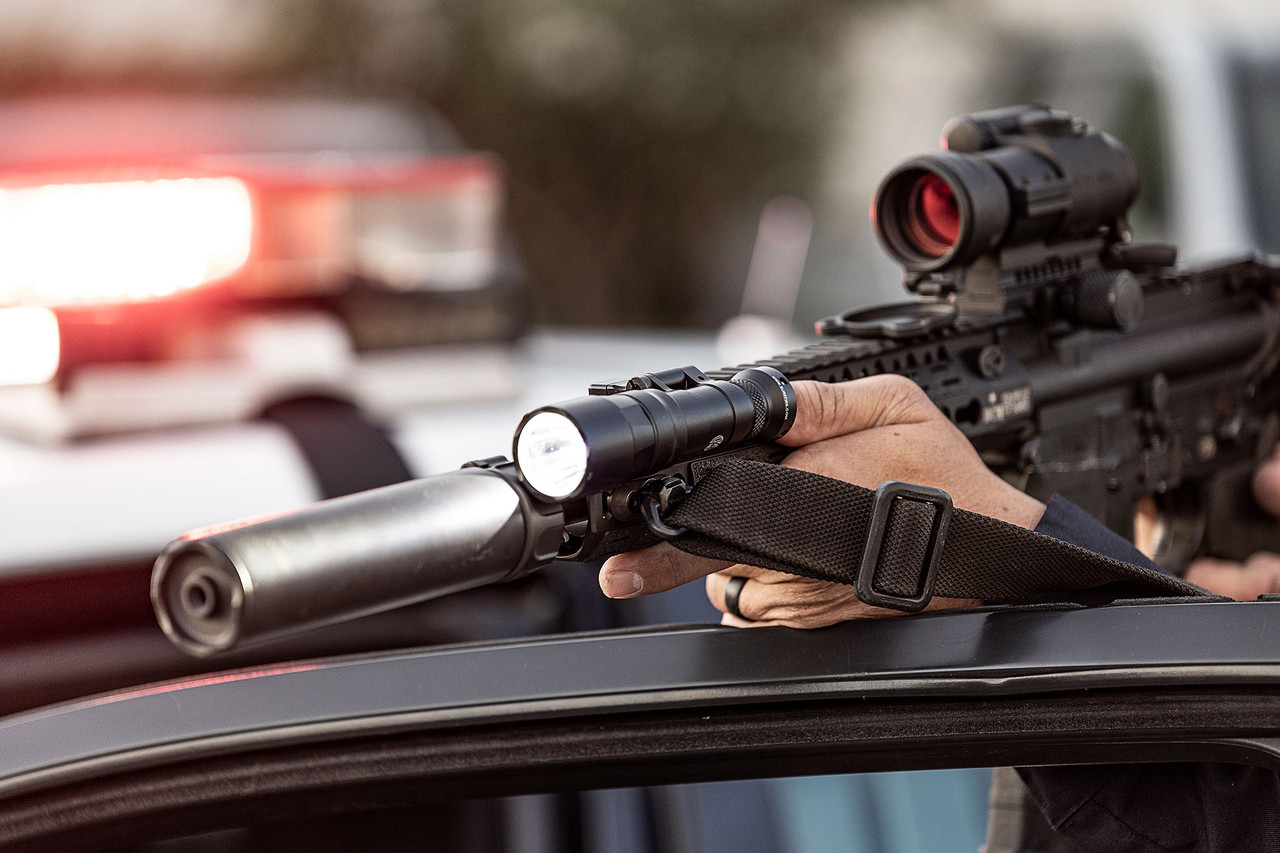
Walk into any serious training class taught in the last fifteen years and look at the firearms on the line. Almost every one of them has a light mounted. That’s not aesthetics — it’s the conclusion thousands of instructors arrived at independently after watching enough students run low-light scenarios.
The weapon-mounted light is still one of the most argued-about pieces of civilian defensive gear, and the objections deserve serious treatment: it makes me a target, it points my gun at people, it adds bulk, my holster won’t fit. None of them, in our experience, outweigh what a properly used WML brings to the table.
The Premise: Fights Happen in the Dark
Before we argue where the light goes, we have to agree it belongs at all. Violent encounters disproportionately happen at night and in low light — a consistent finding across decades of FBI LEOKA data, officer-involved shooting reviews, and force-research literature (e.g. Police Chief Magazine and Force Science low-light studies). Predators prefer reduced visibility because it tilts the encounter in their favor.
What that means for the defender: the encounters you’re training to win are happening in conditions where you cannot reliably see what you’re looking at. Target identification is the single most legally and morally important moment of any defensive use of force, and it depends on light. Without enough to confirm what’s in front of you, you’re guessing — and there is no take-back on the trigger pull.
Handheld vs Weapon-Mounted
The handheld flashlight has been the default for a long time and the arguments for it are real: multi-tool, independent of the firearm, can be held offline from the body. The honest counter: a handheld forces a one-handed grip on the gun, demands manual coordination under stress, and falls apart the moment you need to reload, open a door, or guide a family member. A WML removes every one of those problems.
WML — Pros
What it actually gives you- Two hands on the gun. Full firing grip, full recoil control.
- Light is always aimed where the gun is. No alignment problem under stress.
- Always-on availability. If the gun is in your hand, the light is too.
- No training tax for complex flashlight techniques.
- Off-hand free for doors, rails, kids, malfunctions.
- Photonic disruption. 20,000+ candela wrecks an attacker’s dark adaptation.
WML — Cons
What you have to manage- Points the muzzle at whatever you illuminate. The big one.
- Adds weight and bulk, especially for concealed carry.
- Holster compatibility shrinks — not every model has one.
- Cost. A quality WML runs $150–$400 plus compatable holster.
- Battery management. Dead light is no light. Swap CR123As every 12 months whether the light has been used or not, and cycle SL-B9 / SF18650B rechargeables through a charger monthly.
- Doesn’t replace a handheld. You carry both.
Every item on the right is a problem you can train or gear around. Every item on the left is a capability the handheld light cannot give you.
The Target Concern: Real, But Overstated
The most common objection — the one we hear at the counter twice a week — is that turning on a WML paints you as a target. Bad guy sees the light, shoots at the light, you lose.
Real in theory and dramatically overstated in the civilian context. The scenario where light-as-target costs you the fight is the one where you’re actively hunting through a structure to find someone waiting to shoot back — a military/LE problem, not a civilian one. Civilian defensive encounters are overwhelmingly reactive: the attacker has already identified you, the fight is at conversational distance, and it ends in three rounds in a few seconds. In that environment, the WML does exactly what it’s supposed to: confirms what you’re shooting and dumps enough light into the attacker’s pupils to wreck his vision for the duration of the fight. Use short momentary activations, don’t stand directly behind it, move after lighting something up. The rest is technique.
“You don’t dart from shadow to shadow like an amateur Batman. You’re defending, not hunting.”
The Rule You Cannot Break
Here is the part of this article that matters more than the rest combined. Read it twice.
A weapon-mounted light points to the same location as the muzzle of a loaded firearm. When you turn it on and point it at something, you are pointing a loaded gun at that something. If the something is a person who is not an identified deadly threat, you have committed assault with a dangerous weapon — M.G.L. c. 265 §15B in Massachusetts (titled “Assault by Means of a Dangerous Weapon”), and a felony under analogous statutes in every state we know of.
The mistake made: noise in the house at 3 a.m., grab the bedside gun, walk into the hallway, use the light on the gun to see down the hall because it’s the brightest light on you. You have just pointed a loaded firearm down the hallway where your teenager is coming back from the bathroom. The fact that you didn’t pull the trigger doesn’t change the muzzle direction.
The Verdict: It Goes on the Gun
We’ll cut to it. After weighing both sides, we come down hard on the side of the WML for any firearm you intend to use defensively. The pros are capability gains; the cons are training and gear problems. Narrow carve-outs: deep-concealment sub-compacts where the bulk math doesn’t work (if you carry a P365-class micro, the TLR-7 Sub or TLR-8 Sub is the only realistic option — and many serious carriers in that class skip the WML and run a quality handheld instead), and open-plan homes with reliable ambient lighting. For everything else — the rifle in the safe, the pistol on the nightstand, the duty gun, the truck gun, the EDC of anyone willing to dress around their carry — the light goes on the gun.
Every defensive gun we sell has a rail for a reason. The same engineers who designed the gun designed it to wear a light. The WML isn’t an upgrade — it’s a core part of the system. We’d rather sell you a $600 defensive pistol with a $250 light than an $850 pistol bare.
What to Look For
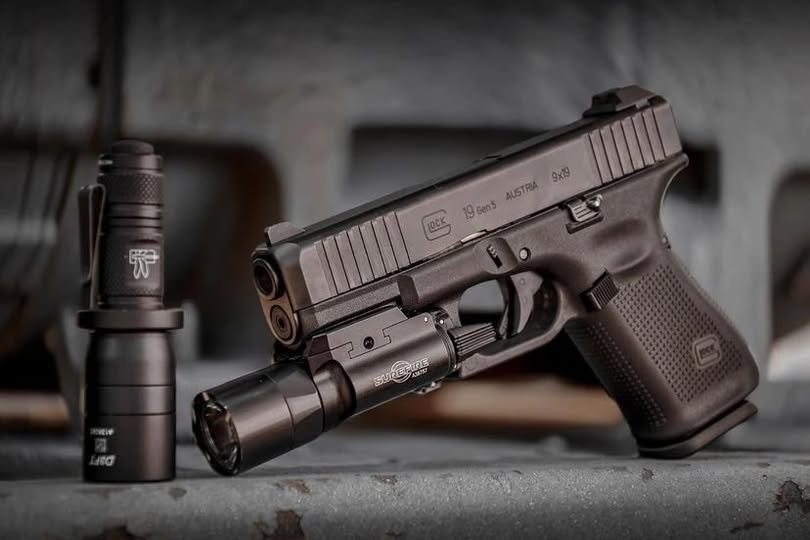
- Candela Over Lumens Lumens are total output; candela is focused beam intensity. Candela is what gets you target ID past 25 yards. Pistol floor: 15,000 candela. Rifle floor: 50,000.
- Reputable Brand, Period SureFire, Streamlight, Cloud Defensive, and recently, Holosun. The light is going to ride on a gun that gets dropped, recoiled, and asked to work in the worst moment of your life. The airsoft light you bought of amazon for $30 isnt designed to withstand the recoil and abuse of a real firearm...
- Switch Ergonomics You have to activate the light without breaking your firing grip. If you can’t turn it on under stress, you don’t have a light.
- Battery Strategy Dual-fuel (rechargeable lithium-ion plus CR123A fallback) is the gold standard — convenience for training, shelf-stable reliability for the gun that sits in the safe.
- Holster Availability Critical for pistols. Confirm there are quality light-bearing holsters for your gun-and-light combo before you buy the light.
Our Favorites
The four lights we actually run on our own guns — and recommend without hesitation when customers ask.
SureFire X300 Turbo
1x CR123A · X300 Holster Footprint
High-candela rewrite of the most-holstered pistol light in America. Throws meaningfully farther than the X300U, fits every existing X300 holster.
View ProductStreamlight TLR-7 HL-X
SL-B9 USB-C or CR123A · TLR-7 Footprint
The high-candela TLR-7. Multi-fuel, compact enough for a Glock 19 carry profile, deep holster support. Our value pick.
View ProductSureFire M640DFT Scout Pro
SF18650B or 2x CR123A · M-LOK + Pic
The hardest-throwing Scout Pro SureFire builds. Dual-fuel, 632-meter reach. The default on serious defensive carbines.
View ProductSureFire M340C Scout Pro
1x CR123A · M-LOK + Pic Included
Small, light, do-it-all. Wider flood beam fits shorter carbines, indoor work, and helmet mounts — same SureFire build quality.
View Product
The Bottom Line
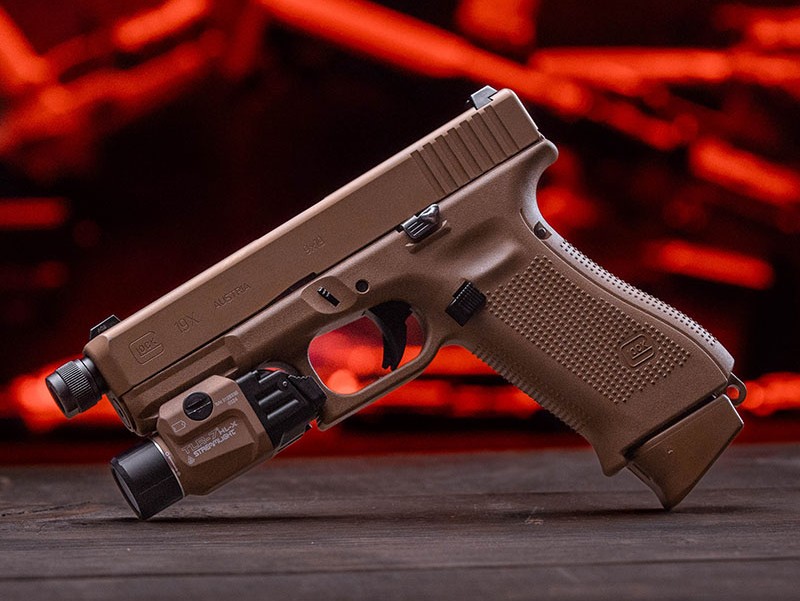
A weapon-mounted light is not the most expensive thing on your defensive gun, but it might be the most important. It doesn’t replace a handheld — you carry both, train with both, and never confuse the two. It doesn’t bypass the law of muzzle direction. And by itself, it doesn’t make you ready for a low-light fight — that part takes training.
What it does is remove failure modes: failure to identify a target before pulling the trigger, failure of running a gun one-handed when the fight demands two, failure of fumbling for a separate light when seconds count. Put a light on the gun. Train with it. Keep a handheld in your pocket. Don’t use the WML to look at things that aren’t threats. That’s the whole playbook.
Come See Them in Person.
We stock the four lights above and a dozen more in the Woburn shop. If you want to handle them on the gun you actually carry and pick the right holster at the same counter, that’s a conversation we’d rather have in person than over a product page.
Shop Weapon Lights Talk to a Dealer
SUN: BY APPT.
MON-TUES: 12PM - 6PM
WED-FRI: 10AM - 6PM
SAT: 10AM - 3PM