
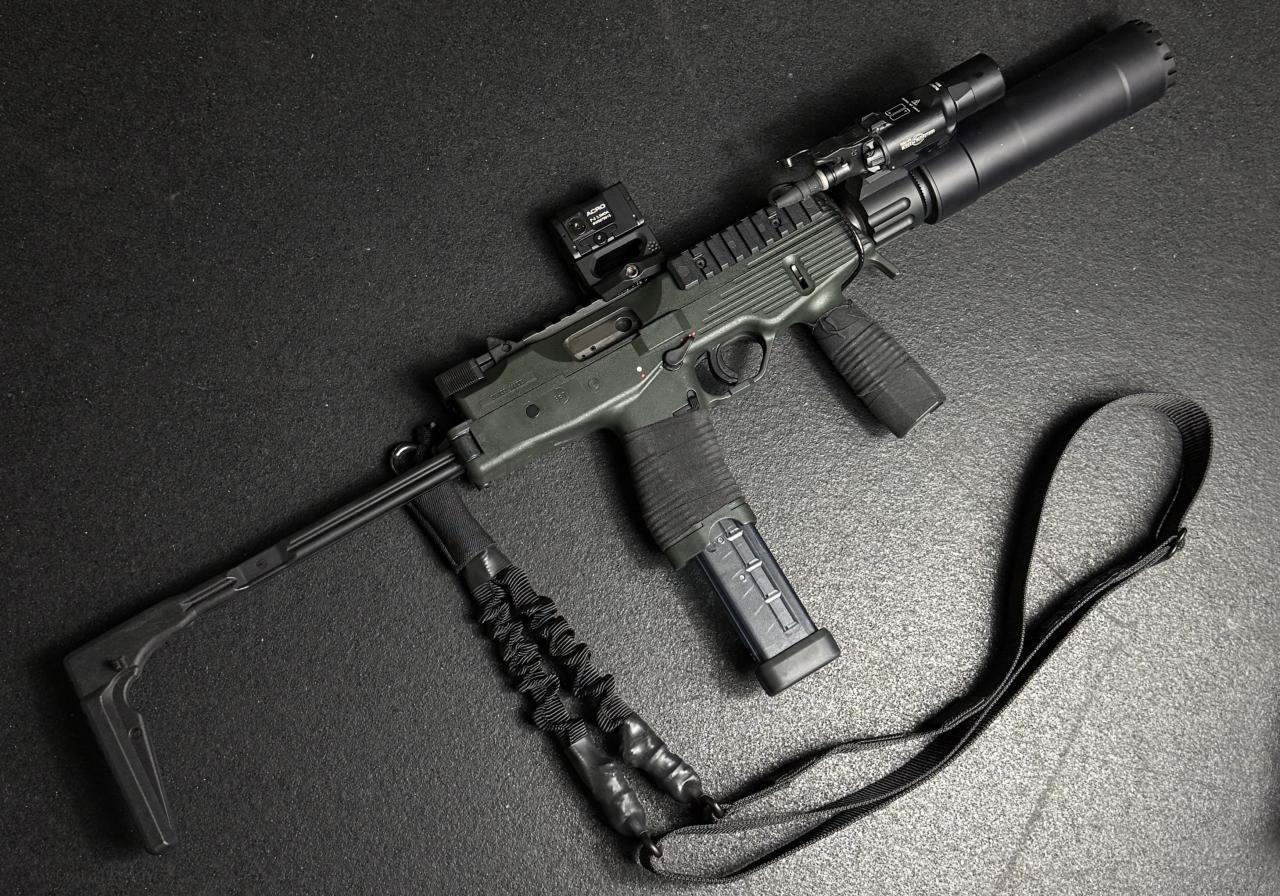
Built for Bursts
B&T — Brügger & Thomet — is a Swiss firm whose entire business is purpose-built weapons for military, law enforcement, and close protection use. They are not a sporting arms company. Their catalog is built around suppressors, machine pistols, PDWs, and integrally suppressed platforms used by units like Germany’s GSG-9, the Swiss Army, Canadian JTF-2, the U.S. Coast Guard MSRT, and various tier-one customers around the globe. When B&T builds something, it is because a serious end-user asked for it, not because the consumer market needed another option.
The MP9 itself has a specific lineage worth understanding. It started life in the early 1990s as the Steyr TMP — a Tactical Machine Pistol designed for close protection details and special operations use. Steyr eventually sold the rights to B&T, who took the existing design, refined it heavily, and re-released it as the MP9 we know today. The civilian-legal version sold in the U.S. is the TP9 — mechanically identical, but neutered to semi-auto only to comply with federal law. This particular gun started its life as a TP9 and was registered and converted to full auto through the appropriate NFA route, returning the platform to its intended configuration.
Why does that matter? Because the MP9 was engineered around exactly one job: putting controllable, accurate full-auto bursts on close-range targets out of a small, concealable package. Every design decision flows from that. When you understand the design intent, the strengths and weaknesses of the platform make perfect sense — including why the semi-auto version is the worst possible version of the gun.
The MP9 is a closed-bolt, locked-breech design with a rotating bolt — uncommon in the 9mm subgun world, where most platforms run a simple straight blowback action. The locked-breech setup gives the MP9 noticeably better consistency, lower felt recoil, and the ability to handle a wider range of 9mm pressure loads cleanly — including hot defensive loads that would beat a blowback gun to death. Cyclic rate sits in the 900-1100 rpm band. The lower receiver is polymer over a steel insert, the stock folds cleanly to the right side of the gun, and the entire package weighs about three pounds empty. It is small, it is fast, and it is comically quick to put rounds on a close-range target.
The fire control group is where the design intent shows itself most clearly — for better and for worse. The MP9 was built around a full-auto sear. Everything in the trigger mechanism is geared toward releasing that sear cleanly under burst-fire conditions. As a side effect, the semi-auto trigger pull on a TP9 is genuinely the worst on the market. It is long, gritty, mushy, with a vague reset and no perceptible wall to prep against. There is no aftermarket fix, no flat-shoe replacement, no polishing job that turns it into something good. You either accept it or you do not buy the gun.
Here is the thing — none of that matters in the configuration this gun was meant to live in. The TP9 sold in the U.S. as a semi-only platform is the worst possible version of this design. You are paying a premium for the engineering of a Swiss full-auto subgun and then running it like a clunky, oversized pistol with the worst trigger in the building. Buying a TP9 and running it semi is paying flagship money for the worst version of the platform — you have missed the entire point of the gun.
The MP9 conversion fixes that completely. Once you can run it the way it was designed to be run — controlled bursts, transitioning to a long single press for follow-up — the awful semi trigger goes from “the worst thing on the market” to “irrelevant,” because you are not aiming with it. You are managing recoil and walking bursts onto target. That is the gun B&T built. That is the gun that finally makes sense.
There is a lot of cope in the gun industry around pistol-caliber subguns and PDWs, and I have to be honest about it. Nine millimeter, out of a five-inch barrel or a seven-inch barrel, is what it is. It is a pistol cartridge. It hits like a pistol cartridge. Compared to a real intermediate rifle round like 5.56x45mm out of an 11.5-inch barrel, it gives up almost everything that actually matters in a serious context — terminal performance, the kind of barrier penetration you actually want, effective range, and consistent behavior against intermediate barriers like glass, sheet metal, and light cover.
If something is happening and I have a choice between this MP9 and an 11.5-inch 5.56 fighting rifle, I am grabbing the rifle every single time. It is not close. The 5.56 platform gives me 200+ yards of effective range, terminal performance that actually does the job on threats, and the ability to defeat soft body armor that a 9mm round will simply not touch. The MP9 is fun. The MP9 is fast. The MP9 is not a fighting rifle, and pretending otherwise is unserious.
Where the MP9 makes sense is in the narrow set of roles a 5.56 rifle cannot fill: close protection details where size and concealability are the entire point, suppressed close-range work where subsonic 9mm is genuinely quiet in a way no rifle round can be, and vehicle storage where you need a serious package in a footprint smaller than a folded SBR. That is the niche. It is a real niche. It is also a narrow one, and being honest about that narrow-ness is the only way to actually appreciate what this gun is good at.
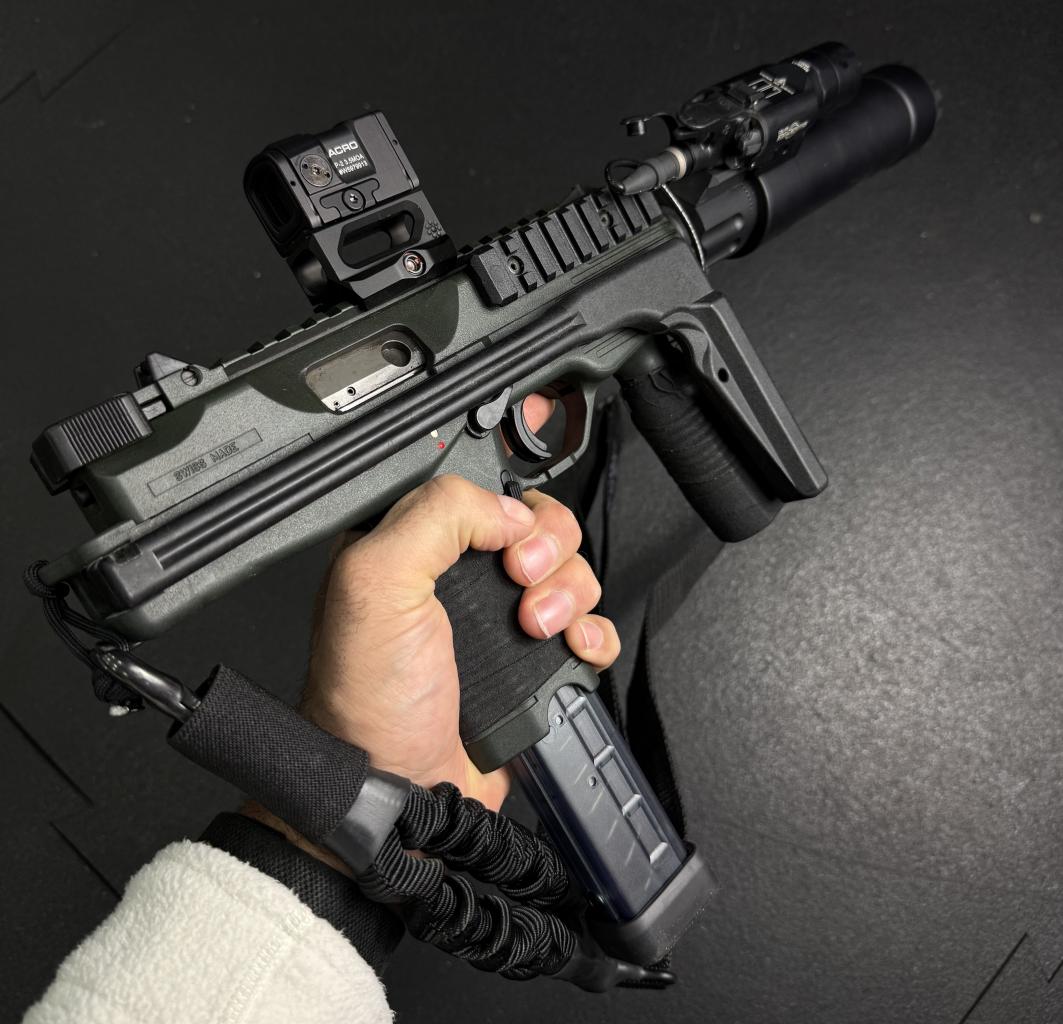
The optic is an Aimpoint Acro P2 sitting on an Arisaka Defense mount. This pairing is exactly the right answer for this platform, and it took me about ten seconds of running the gun to know it.
The Acro P2 is a fully enclosed-emitter red dot — the LED, the battery, and the electronics all live inside a sealed metal housing rather than sitting open between two posts. That distinction matters more on a 9mm subgun than it does almost anywhere else. Gas, fouling, and unburnt powder get absolutely everywhere on a full-auto pistol-caliber platform — meaningfully more than what you see coming out of a 5.56 rifle. An open-emitter pistol dot would gunk up and start flickering inside a few hundred rounds. The Acro’s sealed housing does not care. It is also built to take abuse the way a duty optic should — drops, hard mounts, slide cycles measured in the tens of thousands. It is the right optic for a gun this brutal on equipment.
The Arisaka mount is the right choice because the MP9’s top rail is short, low, and sits directly above the bore. You do not need a riser. You do not need a quick-detach throw lever. What you need is a low, tight, locked-down mount that holds zero and does not move — and that is what Arisaka builds. The dot lines up cleanly with the natural cheek weld on the folding stock, and you are not chasing the optic during recoil.
A magnified optic on this gun would be silly. You are not engaging anything past 50 yards with 9mm, and inside that distance a 1x red dot is faster, easier to drive during recoil, and lets you keep both eyes open and scanning the environment. The Acro is the correct optic. Anything else is overthinking it.
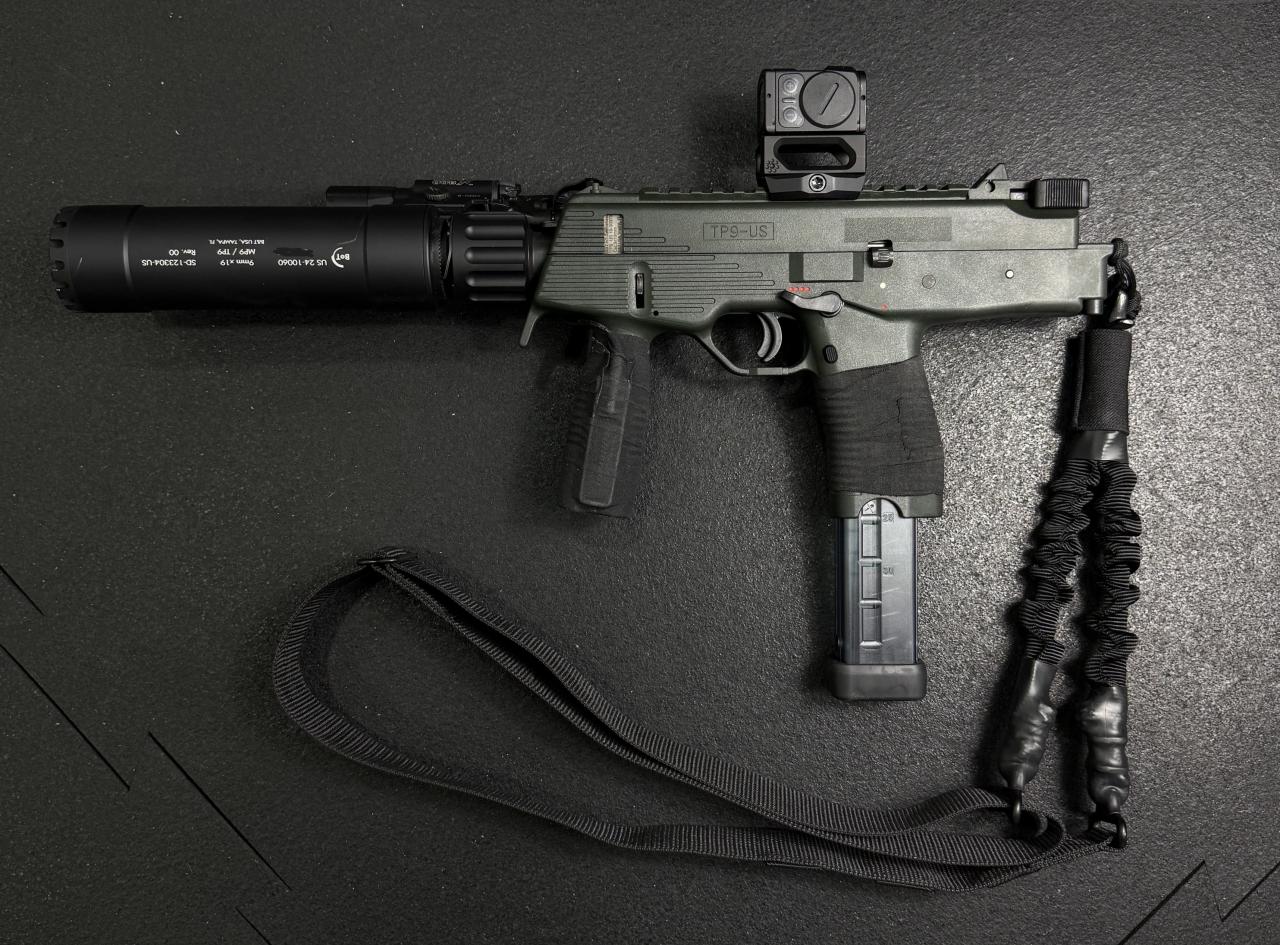
The can is a B&T RBS 9MM — Reduced Back-pressure Suppressor. B&T’s host system on the MP9 means the suppressor mounts cleanly to the gun and was designed alongside the platform from day one, not bolted on as an afterthought. The RBS line is built specifically to reduce gas blowback into the shooter’s face, which is a real and serious problem on suppressed full-auto subguns — every single cycle dumps a full charge of gas into the action and out the ejection port at six inches from your eyes. The RBS handles that cleanly. Running this gun unsuppressed is fine. Running it suppressed with subsonic 9mm is one of the few cases where suppression is genuinely and dramatically meaningful — not Hollywood-quiet, but legitimately hearing-safe and so much more comfortable to shoot than a suppressed rifle round that the comparison is barely fair.
The light is a SureFire X300 Turbo, the high-candela version of the X300 line — 65,000 candela of tight-beam throw rather than the wide flood you get from the standard X300U. On a subgun, the Turbo is the better answer. You are not clearing a hallway looking for spill at your feet; you are identifying and confirming at distance, and the throw matters more than the spread. The Turbo delivers exactly that.
Wired into the rail is a SureFire ST07 tape switch. Momentary activation under your support hand thumb, no toggle to fumble, no constant-on to forget. You press, the light is on. You release, the light is off. On a gun that is already a handful to run cleanly under recoil, taking the manipulation out of the light is the right call — you do not want to break grip to reach the bezel, and you definitely do not want to be hunting for a clicky switch in a hurry. ST07 is a clean, proven setup. Nothing more to say.
This is where I have to be honest about the platform’s biggest weakness. The MP9 is fussy. It is a Swiss-engineered precision machine and it demands to be treated like one.
Every quality 5.56 fighting rifle I own — properly built DI guns from properly built manufacturers — will run thousands of rounds between detail cleanings with nothing more than a quick wipe and a spritz of lube on the bolt and bolt carrier. They are not delicate. They tolerate dirt, neglect, and abuse to a degree that would make most pistol-caliber guns choke and die. You can run a quality 5.56 rifle dirty and it will still shoot. That is the whole point of the platform.
The MP9 is the opposite. The platform demands a complete breakdown and detail cleaning every 600 rounds. No questions, no exceptions. If you push it past that, you start seeing problems — failures to feed, light strikes, fussy ejection, stoppages that should not be happening on a gun in this price tier. This is not a gun you can run dirty and forget about. The tolerances are tighter than what you find on a 5.56 rifle, the gas environment inside the action is significantly messier, and the moving parts are more sensitive to fouling.
That is the cost of admission for Swiss engineering at this level. The same tight tolerances that make the MP9 controllable, accurate, and reliable when clean also make it intolerant of neglect. If you treat it like a fighting rifle and feed it neglect, it will let you down. If you treat it like the precision instrument it is and clean it on schedule, it will run forever. Know what you are buying before you buy it.
| Component | B&T MP9 |
|---|---|
| Platform | B&T MP9 (NFA-converted from civilian TP9) |
| Action | Closed Bolt, Locked Breech, Rotating Bolt |
| Caliber | 9x19mm Parabellum |
| Cyclic Rate | ~900–1100 RPM |
| Barrel | 5.1″ Cold Hammer Forged |
| Receiver | Polymer over Steel Insert — Side-Folding Stock |
| Optic | Aimpoint Acro P2 |
| Optic Mount | Arisaka Defense Acro Mount |
| Light | SureFire X300 Turbo — 65,000 Candela |
| Switch | SureFire ST07 Tape Switch |
| Suppressor | B&T RBS 9MM — Reduced Back-pressure |
| Weight (Empty) | ~3.0 lbs |
SUN: BY APPT.
MON-TUES: 12PM - 6PM
WED-FRI: 10AM - 6PM
SAT: 10AM - 3PM